Sunday, April 04, 2021

How Long Will Red Sox Continue to Tolerate Rafael Devers' Defensive Shortcomings?


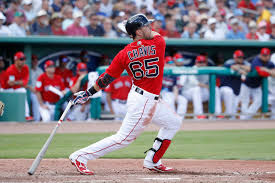
That "E" behind Rafael Devers has become very symbolic.


The first two games of the 2021 season have only added to the ongoing concerns about Rafael Devers' ability to adequately play third base. For the past couple of years, his continuing miscues have led many to suggest that he needs to be shifted across the diamond to first base. 


In 2017, his rookie season, Devers committed the fourth-most errors (14) among MLB third baseman, despite playing in just 56 games. In 2018, Devers led the major leagues with 24 errors. In 2019, he led all major league third basemen with 22 errors. Last season, he once again led the majors with 14 errors in just 57 games. Additionally, Devers had the lowest fielding percentage among major league third basemen in two of the past three seasons.


A really troubling pattern has been established, and it can no longer be ignored. 

The idea has been floated, in the media at least, of moving Devers to first base and shifting Bobby Dalbec, a natural third baseman, to the hot corner. However, Devers has never played first and he would likely bring his defensive struggles with him across the diamond.  


And the designated hitter spot is blocked by JD Martinez, who is under contract through the 2022 season. 

The Red Sox may be running out of patience with Devers. And he could face some strong internal pressure from within the organization.

Tristan Casas is ranked as to the top prospect in Boston's farm system and No. 44 overall by MLB.com. The 21-year-old has played both first and third base in the minors, as has current first baseman Dalbec. Last year, I suggested that the Sox could shift Dalbec to third when Casas is brought to the majors, making Devers a trade chip.

While it might seem outlandish to suggest trading Devers, a player who is just 24 and isn’t eligible for free agency until after the 2023 season, he is a stone-cold defensive liability and his four-year track record is not an aberration. His youth and affordability would would make him an attractive trade chip to many clubs, who might be able to use him as a DH. As always, the Red Sox need starting pitching. 

However, Casas has just 433 minor league at-bats, meaning he is not yet ready for the majors. He will open this season with the High-A Greenville Drive, likely putting him at least a year or year-and-a-half from the majors. 

The problem is that the Sox may not be able to wait that long for Devers. His defensive shortcomings are the kind of liability that results in losses. One way or another, this cannot continue indefinitely. 

If Devers can revert to his 2019 offensive form, when he batted .311, slugged .555 and led the majors with 359 total bases, it could make up for his defensive miscues. In essence, he may be able to win more games with his bat than he’ll lose with his glove. But, after his reversion in 2020, that possibility remains nothing more than hope right now.  

Thursday, April 01, 2021

Red Sox 2021 Preview: This Team Will Go As Far As the Rotation Takes Them


It's Opening Day! 

But what are we to make of the 2021 Red Sox? Well, the offense should be robust, for sure. But the starting pitching? That's what it will all come down to for this team, as with most others.

Though it may be hard to believe, the Red Sox actually led the American League with a .265 batting average last season. They also ranked third in on-base percentage (.330), slugging percentage (.445), and OPS (.776). And the Sox were also fifth in runs per game (4.87).

Yet, they did all of this in the absence of Mookie Betts and, largely, Andrew Benintendi.

Furthermore, J.D. Martinez looked like a high school hitter all season and Rafael Devers also regressed. Additionally, the Sox got essentially zero production from second base.

The takeaway is that offense was not the problem for Boston last season, and it will not be this season either. Martinez and Devers will revert to their norms, Kiki Hernandez will be an upgrade at second, Bobby Dalbec will have a full season to launch homers, and Alex Verdugo looks like an emerging All Star. Even Hunter Renfroe looks tailor-made for Fenway.

The initial evidence is already solid.

The Red Sox offense was very potent during spring training. Amongst all teams in both Grapefruit League and Cactus League action, Boston finished first in RBI (151), second in batting (.270), second in slugging (.487), second in OPS (.831), second in homers (45) and second in runs (159).

This team is built to score, and it appears they will need to do so prodigiously in order to compete this season. That’s because the starting pitching may, once again, be their Achilles heel.

Amongst all clubs, Boston's starters finished spring training 15th in opponents' batting average (.258), 16th in ERA (4.94), 17th in strikeouts (84), 19th in WHIP (1.38) and fourth-worst in walks (38).

Yes, it was only spring training, but if we're going to be excited and optimistic about the offense, then we need to be equally troubled by the starting pitching.

Those concerns only grew when it was announced that No. 1 starter Eduardo Rodriguez was suffering from a "dead arm" and was scratched from his Opening Day start at Fenway. He will start the season on the Injured List.

E-Rod looked fantastic this spring (13.2 IP, 11 hits, 15 Ks, 2 BB, 2.63 ERA), showing no ill-effects from missing the 2020 season. Perhaps this is just a bump in the road; we can only hope. But it's certainly worrisome.

The extended time off may have simply left Rodriguez's arm/shoulder weak and deconditioned, a matter that can be remedied by the training staff and a highly-structured throwing program. Again, we can only hope.

In his stead, Nathan Eovaldi, who has a 6.60 ERA this spring, will make his second-straight Opening Day start.

The starting pitching needs to be markedly better this season in order for the Sox to be competitive, or even worth watching.

Last season, Boston’s starting rotation had a 5.34 ERA, which was 13th out of the 15 teams in the AL. Red Sox pitchers allowed 5.85 runs per game, the most for the franchise since 1932. The Sox’ pitching was so bad that, despite their potent offense, they still had the fifth-worst run differential (-59) in the majors.

That's because the Red Sox used 16 different pitchers to start games in a mere 60-game season. For perspective, the 2004 Red Sox used eight starters over 162 games. The 2007 champs used nine starters, while the ’13 and ’18 champs each used 11.

The 2020 Red Sox employed a bunch of starters we'd never heard of. The list included guys like Ryan Weber, Matt Hall, Zack Godley, Andrew Triggs and Chris Mazza, as well as relievers Mike Kickham, Josh Osich, Robinson Leyer and Austin Brice. Old friends Ryan Brasier and Colten Brewer even made starts last year.

When the season ended, the club began jettisoning all of that flotsam and jetsam. The Sox also bid farewell to Dylan Covey, Robinson Leyer, Jeffrey Springs and Kyle Hart.

If you weren’t keeping track, 12 of the 15 pitchers listed above are either no longer with the organization or are off the 40-man roster. In essence, the majority of the pitching staff was remade in a single offseason. Thank goodness.

The rotation should, in theory, be much improved this season, highlighted by the return of Rodriguez, who suffered a COVID-related heart infection that derailed his 2020 season.

The most significant free agent addition to the staff is righty Garrett Richards, who is expected to be a big improvement from the host of Triple-A pitchers that made starts for Boston last year. The 32-year-old has amassed a 3.62 ERA and 1.26 WHIP over 10 seasons. Those are appealing numbers, and from 2014-2015 Richards looked like a budding ace with the Angels, until injuries derailed his career.

Richards was limited to six just starts apiece in 2016 and 2017, 16 starts in 2018, and a mere three starts in 2019, when he underwent Tommy John surgery. In the pandemic-shortened 2020 season, the righty made 10 starts for San Diego. Consequently, Richards hasn’t pitched more than 76 ⅓ innings in any season over the past five years. Overall, he's thrown just 198 2/3 total innings since the start of 2016.

It should worry Red Sox’ fans that over the past decade Richards has made at least 30 starts just once, and at least 25 starts just twice. The optimist will say he's well-rested. In reality, he’ll be quite limited this season. It’s reasonable to wonder if he can he even reach 150 innings; I’m dubious. If he can stay healthy, Richards could be a nice pickup for Boston. But there are just so many ifs.

Righty Nick Pivetta, who made two starts for Boston late last season, has always been intriguing because of his power arm and pure stuff. The Red Sox are hoping they can finally harness it. However, it can’t be ignored that Pivetta has a 5.40 ERA over more than 400 innings in the majors. The whole sales pitch with this guy is "potential."

The Sox will rely heavily on Eovaldi, who has made at least 30 starts just once in nine seasons. The righty has been plagued by injuries throughout his career.

Then there's Martín Pérez, who has a 4.70 ERA and 1.48 WHIP after nine seasons, in which he's made at least 30 starts just twice. The lefty is nothing more than a fifth starter.

There are questions everywhere. Who can be relied on to make at least 30 starts and throw at least 150 innings for Boston?

Tanner Houck, who has made just three major league starts, is the primary Triple-A depth option. He will open the season with the big league club and start the second game of the season.

Finally, Chris Sale will return some time this summer, which will provide the rotation with an enormous boost. He may not be back to full strength right away, but even at 80%, Sale is still better than most MLB pitchers.

Rule-5 draft pickup Garrett Whitlock could be a nice surprise. The righty was terrific in Grapefruit League action, throwing nine innings and allowing one run on eight hits and no walks. Oh, and he fanned 12 along the way. It shouldn't come as much of a surprise; Whitlock has a 12-8 record and a 2.41 ERA in 42 Minor League appearances (38 starts). Whitlock was particularly impressive in 2018, notching a 1.86 ERA over 23 appearances for three affiliates. That's why the Sox snatched him from the Yankees.

Whitlock will start the season in the bullpen, but he provides a nice depth option for the rotation. The question is whether he can be stretched out to start, if needed, and if the Sox are even willing to lean on a rookie pitcher who is just returning from Tommy John surgery.

The Sox desperately need to take a big leap forward from the misery and disappointment of last season. The 2020 Red Sox ended with a .400 winning percentage, which was the fourth worst in baseball.

Despite their abysmal season, the Sox had the third-highest payroll in baseball last year. No, this ownership group has never been stingy.

Though some fans may think the Red Sox have been cheap this offseason or, at the least, are disappointed that the team didn't sign any high-dollar free agents, it's worth noting that Boston's $205 million payroll is the second-highest in baseball after the Dodgers ($256 million).

The reality is that the Sox spent nearly $45 million on half a dozen free agents and a couple of trade acquisitions this winter. Instead of signing one or two really expensive free agents, Chaim Bloom decided to strategically allocate available dollars to multiple players, many of whom are quite versatile and offer flexibility in the field or the bullpen.

Sale, who will make $30 million this season, is the club's most expensive player, by far. After that, Xander Bogaerts represents a relative bargain at $20 million. And JD Martinez will make $19.375 million this year, which will also be a bargain if he reverts to his usual highly-productive self.

There is some dead weight on the roster this year, much of which will come off the books at season's end.

The Sox will pay newly retired Dustin Pedroia $12 million this season and they will pay the Royals $2.8 million toward Andrew Benintendi's 2021 salary. Additionally, the Sox will pay the Dodgers $16 million for David Price this season and next.

Add it all up and the Sox will be paying nearly $31 million this year for those three players to suit up for other clubs or not play at all.

We can bemoan guaranteed contracts, but that's the nature of the sport. This isn't the NFL.

After the 2022 season concludes, the Red Sox will have a lot of money to spend in free agency, and many of their top prospects should be graduating onto the big league roster. Good days lie ahead for Boston.

What’s particularly striking is just how much change this roster has undergone in only a couple of years. Just nine players remain from the Red Sox 2018 World Series roster, which was unimaginable even after the 2019 season. Those nine are: Matt Barnes, Ryan Brasier, Nathan Eovaldi, Eduardo Rodriguez, Chris Sale, Christian Vazquez, Xander Bogaerts, Rafeal Devers and JD Martinez.

As for this season, many prognosticators seem to think that the Sox will be a .500 ball club. Vegas puts Boston's odds of winning the World Series at 50/1. Obviously, this team's hopes are almost entirely hinged to a starting rotation that has more questions than answers. They will go as far as the starting five (or six or seven or whatever) will take them.

Given their potent offense, I think the Sox are capable of 85 wins this season, which should be good enough for third place in the ever-challenging AL East.

Let's check back in October and see how it all panned out.

In the meantime, play ball!

Friday, March 05, 2021

Red Sox Low-Key Signing of Danny Santana May Provide Big Payoff


The Red Sox yesterday agreed to a Minor League deal with free-agent infielder/outfielder Danny Santana. The agreement includes an invitation to Spring Training for the 30-year-old veteran of seven major league seasons.

At first glance, this is a rather ho-hum signing. After all, it's just a minor-league deal. Furthermore, Santana has compiled a rather pedestrian .260/.299/.418/.717 slash line over more than 1,700 career plate appearances.

However, a look below the surface reveals a player with an interesting skill set and the potential to help the Red Sox this season.

Firstly, Santana in 2019 batted .283 with 28 homers, 81 RBI, 81 runs scored, 21 steals, and an .857 OPS over 130 games. That, alone, is eye-popping.

Secondly, Santana is a switch-hitter, which provides versatility at the plate, allowing manager Alex Cora to manipulate the batting order.

Lastly, Santana can play every position except catcher. Remarkably, like Kiké Hernández and Marwin González, Santana can play all four infield positions and all three outfield positions.

Santana's career defensive starts have been broken down like this: 132 games in center field; 104 at shortstop; 47 in left field; 51 at first base; 20 in right field; 16 at second base; and 12 at third base.

This could end up being a sneaky-good signing by Chaim Bloom; an under-the-radar move that we look back upon with amazement.

One way or another, it's certainly a low-cost deal for Boston. Santana will earn a $1.75 million base salary if he makes it to the majors and up to $1 million in incentives. There’s a $100,000 bonus if he starts the season in Triple-A, which means that he won't opt out in the spring. Having that kind of minor-league depth could prove to be invaluable to the Sox this season.

It remains unknown when Santana will be ready for action. He suffered an elbow injury last year that limited his 2020 season to just 15 games, and ultimately led to a right UCL repair on Sept. 9; the surgery required an internal brace. So, he may need some minor league prepping in advance of a big league promotion.

One thing is for sure: Santana's signing puts a lot of pressure on both Michael Chavis, who has minor league options, and Christian Arroyo, who doesn't. The latter will need to come out of the gate on fire or he risks losing his roster spot to the versatile Santana early in the season.

Sunday, February 14, 2021

Michael Chavis: A Man Without a Position, Who Could Be a Man Without a Job


For Michael Chavis, the upcoming season with the Red Sox could be make or break. The 25-year-old will be battling for a roster spot in spring training, which is no sure thing since he still has minor-league options remaining. 

Chavis is a utility-man with no clear position. He plays second base well enough to fill in a couple of days a week, but not full time. He’s also played first base, but strictly in a platoon role, and he even played 12 games in left field last season. That sort of inconsistency doesn’t benefit most players, and it certainly makes it hard to shine. 

In 2019, Chavis slashed .254/.322/.444/.766 over 382 plate appearances (PA). His 18 home runs ranked second among MLB rookie second basemen, while his 58 RBI ranked first. However, there was an early warning sign when he struck out in 127 of those 382 PAs, in what amounted to a 33% strikeout rate.

However, Chavis regressed in 2020, when he slashed .212/.259/.377/.636 over 158 plate appearances. While his home run output dropped to five long balls, his strikeout percentage remained a worrisome 32%, which put him in the bottom 9% of the league. In August, he became just the fourth batter in Red Sox franchise history to strike out five times in a game.

Since he is just 25, has raw power and remaining options, Chavis still has value. But he can’t catch up to the high heater, and pitchers know this. Since he hasn’t been able to make the necessary adjustments to fix the hole in his swing, this major flaw will continue to be exploited. Though his positional diversity gives Chavis some value, he doesn’t look like an every day player at any one position. 

The signings of Kike Hernandez and Marwin Gonzalez have certainly limited Chavis’ opportunities at second base, where Christian Arroyo and Jonathan Arauz will also battle for playing time. It’s worth noting that Arroyo is out of minor-league options, so he can’t be sent to Triple-A without first passing through waivers, where he wold likely be claimed. That gives him an edge over Chavis to start the season. It should also be noted that the Red Sox need to open two 40-man roster spots to make room for Gonzalez and reliever Hirokazu Sawamura. That puts Chavis on the hot seat.

Defensively, Arroyo and Arauz are both superior to Chavis, whose calling card has always been his power stroke. So, if he’s not hitting bombs on a regular basis, yet continues to whiff in one-third of his plate appearances, Chavis will be on the outside looking in — a man without a job. 

The Red Sox are apparently trying to trade Chavis, though Chaim Bloom is said to have a high asking price. If you’re wondering why, again, Chavis is still just 25 and comes with five more seasons of club control. Add those assets to his power and his ability to play first, second and third (his natural position), and he has some value. 

Chavis needs to prove that value to the Red Sox and/or some other potential trade partner this season or he may find his big league career coming to a rather abrupt end. Sure, he could be sent back to the minors, continually waiting for a call to fill in for an injured player. But that’s not the life that any player wants to live after he's spent at least a year on a big-league roster.

That’s why this season is make or break for Chavis. We can hold out hope. After all, he’s just entering what should be his prime. 

Friday, February 12, 2021

Goodbye and Farewell, Andrew Benintendi. We'll Miss What Might Have Been.

Andrew Benintendi makes a balletic catch in the 2018 World Series at Fenway Park


The start of Andrew Benintendi’s Red Sox career was tantalizing. He finished second in the Rookie of the Year voting in 2017, after hitting .271 with 20 homers, 20 steals and 90 RBI.

In 2018, Benintendi took off like a rocket and entered the All-Star break hitting .297 with 14 homers, 57 RBI and an excellent .897 OPS. But then things quickly went south for "Benny." He hit .279 with just two homers and a .727 OPS in the second half.

In 2019, his decline was unmistakable. Benintendi slashed a tepid 266/.343/.431/.774, with 13 homers and 68 RBI. His home runs and RBI had declined for two successive years. Meanwhile, his walks dropped to a career-low 59, and his strikeouts soared to a career-high 140. This all occurred when he was just 24, in what should have been the prime of his career.

Though his 2020 campaign was cut short due to a rib injury, Benintendi looked utterly lost at the plate. He hit just .103 in 39 at-bats before it all came to a sudden halt. Little did we know that it would be the last time we'd see him in a Red Sox uniform. 

It’s really not a surprise in retrospect. Since the beginning of the 2019 season, Benintendi put up a .255/.341/.410 line, with just 13 homers in 667 plate appearances.

When I saw internet photos of Benintendi’s offseason training regimen over the last couple of years, I became concerned. He looked like he was trying to become a bodybuilder, rather than a baseball player focused on sport-specific training that would improve his on-field skills, such as sprinting, leaping and injury prevention. When I heard the nickname “Benny Biceps,” which resulted from those offseason training sessions, I felt like he was on the wrong track.

Sure enough, Benintendi now admits that he became obsessed with launch angle and generally trying to blast the ball out of the park.

“There was an effort on my end to get the ball in the air more,” Benintendi told the media after the trade. "I was going up there trying to hit for more power. I’m 5-foot-9, 175 pounds, so I know I’m not going to be up there hitting 30 homers a year.

At least he finally recognizes it. Too bad he didn’t catch on sooner. His career might not have stalled and he’d still be in Boston, rather than Kansas City.  

Whatever Benintendi was doing in his workouts, none of it seemed to help. Most shockingly, he went from fleet-footed to lead-footed in just a couple of years. Alex Speier of the Boston Globe wrote the following:

"The big league average sprint speed is about 27.0 feet per second. When Benintendi reached the big leagues in 2016, Statcast measured his average sprint speed at 28.6 feet per second—a mark that ranked as elite, the 89th percentile in the majors. His speed has declined in each subsequent year, down to a below-average mark of 26.6 in 2020 (again, small sample size warnings are necessary).

Evaluators say that Benintendi’s lack of speed disqualifies him from manning center field, and that his range in left has become quite limited too. So, there is more to Benintendi’s sudden and stark decline than just his offensive struggles.

So much was expected of Benintendi after being selected with the seventh pick in the 2015 draft. That’s the nature of being drafted that highly; you’re expected to perform and to excel. For a while, Benintendi was meeting those expectations. And his defense was sound enough for him to make two superlative catches in the 2018 postseason.

First, there was his diving grab, with the bases loaded, for the final out of Game 4 of the American League Championship Series against the Astros. Then there was his highlight-reel, leaping grab in front of the Green Monster in Game 2 of the World Series against the L.A. Dodgers. It was breathtaking stuff. 

Benintendi looked like a star for about a year-and-a-half, until he didn’t for about two years. It’s all hard to figure, and it’s actually sad. He was easy to root for. He's handsome, unassuming and has a folksy charm. His hair was so perfect that it looked like it should have its own agent. 

Now all three of the Red Sox brilliant young outfielders from the 2018 Championship team are gone: Benintendi, Mookie Betts and, likely, Jackie Bradley. That was unimaginable just two years ago. Such is the nature of pro sports; it's a “what have you done for me lately?” business.  

We’ll all root for Benintendi from afar as he suits up for the Royals. After all, we grew to really like the guy. We’ll hope he gets his career back on track, but maybe not too on track. It would be awful to see him resume an All Star trajectory in another team’s uniform, wouldn’t it?  

In the meantime, we can remember the good times with Benny in Boston, and we can remember that the Red Sox ultimately received five players in exchange for him: Franchy Cordero and four prospects. Aside from pitcher Josh Winckowski, we don’t know who the other three will be. Since the 2020 minor league season was cancelled, there was no way for the Red Sox (or anyone else) to evaluate these minor leaguers. Boston likely has an agreement with the Royals and Mets to create a list of players that pique their interest this season, from which they can then choose. So, it’s far too early to gauge the return for Benintendi at this point. 

Some may feel that the Red Sox sold low on Benintendi, and that the club would have been better off seeing if he can bounce back this season before dealing him. However, the Red Sox scouts and talent evaluators have been watching Benintendi’s progression and regression for four-plus seasons, so they know the player well. Apparently, they’ve concluded that Benintendi has reached his ceiling, which is lower than any of them ever thought. 

As Red Sox fans, we can only hope they’re right. As it is, we'll always wonder what might have been.

Monday, February 01, 2021

Thanks for the Memories, Dustin Pedroia


Dustin Pedroia’s great career has unfortunately, yet expectedly, come to an end.

The second baseman leaves the game firmly established as one of the greatest Red Sox players of all time, and his numbers back it.

Pedroia ranks among the top 10 in Red Sox history in seven different categories: hits (8th), doubles (6th), 
extra-base hits (8th), total bases (8th), runs (10th), steals (6th) and at-bats (9th).

Pedroia won the American League Rookie of the Year Award in 2007 and backed that by winning the American League MVP Award in 2008. He also won two World Series, four Gold Gloves, a Silver Slugger, and went to four All-Star Games during his career.

While Pedroia is listed as having a 14-year career, in reality he played just 11 seasons. He was a late-season call up in 2006 and played in only 31 games. And he was limited to a mere nine games over his last two seasons due to his damaged knee. So, Pedroia’s illustrious career was forged over eleven MLB seasons, and what he did in that span is truly impressive.

From 2007-2017, Pedroia established himself as one of the best all-around players in baseball. Over that span, he slashed .302/.368/.442, with 138 home runs and 138 steals. 

His knee troubles began in October 2016, when he had surgery to repair a torn meniscus in his left knee. Then Manny Machado spiked him at second base in April, 2017 and his left knee was never again the same. Pedroia had a total of four knee surgeries in 26 months, but none of them could get him back on the diamond, pain free and fully mobile again. 

Through 2017, Pedroia appeared to be on track for the Hall of Fame. But, being limited to just 11 seasons likely derailed his train to Cooperstown. Being held to a mere nine games from 2018-2020, a three-year stretch when he was still in his mid-30s, really limited Pedey's final career numbers and Hall of Fame credentials. If he'd remained healthy, he surely would inflated his stats considerably.

Pedroia finishes his career with a .299/.365/.439 batting line, 140 home runs, 394 doubles, 15 triples, 138 stolen bases, 1,805 hits, 922 runs scored and 725 runs batted in. His career batting average dipped below .300 because he went 2 for 20 in his brief 2019 comeback attempt.

The second baseman totaled 5 wins above replacement (WAR) six times in a nine-year span, including a whopping 8 WAR in 2011, a year in which he finished ninth in the MVP voting.

A player who totals 5 wins above replacement would typically be considered an All-Star and a player with a WAR of 8 or higher is typically an MVP candidate. 

Baseball-Reference credits Pedroia with 51.6 wins above replacement. However, the average Hall of Famer has a Baseball-Reference WAR of 63.2. 

Additionally, Bobby Grich has a career WAR of 71.1 and Lou Whitaker’s is 75.1. Both were second basemen and neither are in Cooperstown. 

Though he may not end up enshrined in the Hall of Fame, Pedroia clearly established himself as one of the greatest players of his generation and one of the greatest Red Sox of all time. And he was surely one of the most popular players of his time, both in Boston and beyond. Those are all fantastic achievements.

Undoubtedly, Pedroia has cemented his place in the Red Sox Hall of Fame, and in the hearts of Red Sox Nation. He had one hell of a career and he was beloved by his teammates, coaches, ownership, and even the Boston media. 

That’s all worth celebrating today, and every time we think of the "Laser Show” in the years ahead.