Sunday, February 14, 2021

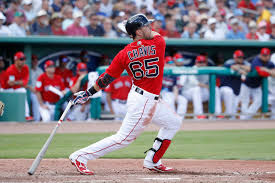
Michael Chavis: A Man Without a Position, Who Could Be a Man Without a Job


For Michael Chavis, the upcoming season with the Red Sox could be make or break. The 25-year-old will be battling for a roster spot in spring training, which is no sure thing since he still has minor-league options remaining. 

Chavis is a utility-man with no clear position. He plays second base well enough to fill in a couple of days a week, but not full time. He’s also played first base, but strictly in a platoon role, and he even played 12 games in left field last season. That sort of inconsistency doesn’t benefit most players, and it certainly makes it hard to shine. 

In 2019, Chavis slashed .254/.322/.444/.766 over 382 plate appearances (PA). His 18 home runs ranked second among MLB rookie second basemen, while his 58 RBI ranked first. However, there was an early warning sign when he struck out in 127 of those 382 PAs, in what amounted to a 33% strikeout rate.

However, Chavis regressed in 2020, when he slashed .212/.259/.377/.636 over 158 plate appearances. While his home run output dropped to five long balls, his strikeout percentage remained a worrisome 32%, which put him in the bottom 9% of the league. In August, he became just the fourth batter in Red Sox franchise history to strike out five times in a game.

Since he is just 25, has raw power and remaining options, Chavis still has value. But he can’t catch up to the high heater, and pitchers know this. Since he hasn’t been able to make the necessary adjustments to fix the hole in his swing, this major flaw will continue to be exploited. Though his positional diversity gives Chavis some value, he doesn’t look like an every day player at any one position. 

The signings of Kike Hernandez and Marwin Gonzalez have certainly limited Chavis’ opportunities at second base, where Christian Arroyo and Jonathan Arauz will also battle for playing time. It’s worth noting that Arroyo is out of minor-league options, so he can’t be sent to Triple-A without first passing through waivers, where he wold likely be claimed. That gives him an edge over Chavis to start the season. It should also be noted that the Red Sox need to open two 40-man roster spots to make room for Gonzalez and reliever Hirokazu Sawamura. That puts Chavis on the hot seat.

Defensively, Arroyo and Arauz are both superior to Chavis, whose calling card has always been his power stroke. So, if he’s not hitting bombs on a regular basis, yet continues to whiff in one-third of his plate appearances, Chavis will be on the outside looking in — a man without a job. 

The Red Sox are apparently trying to trade Chavis, though Chaim Bloom is said to have a high asking price. If you’re wondering why, again, Chavis is still just 25 and comes with five more seasons of club control. Add those assets to his power and his ability to play first, second and third (his natural position), and he has some value. 

Chavis needs to prove that value to the Red Sox and/or some other potential trade partner this season or he may find his big league career coming to a rather abrupt end. Sure, he could be sent back to the minors, continually waiting for a call to fill in for an injured player. But that’s not the life that any player wants to live after he's spent at least a year on a big-league roster.

That’s why this season is make or break for Chavis. We can hold out hope. After all, he’s just entering what should be his prime. 

Friday, February 12, 2021

Goodbye and Farewell, Andrew Benintendi. We'll Miss What Might Have Been.

Andrew Benintendi makes a balletic catch in the 2018 World Series at Fenway Park


The start of Andrew Benintendi’s Red Sox career was tantalizing. He finished second in the Rookie of the Year voting in 2017, after hitting .271 with 20 homers, 20 steals and 90 RBI.

In 2018, Benintendi took off like a rocket and entered the All-Star break hitting .297 with 14 homers, 57 RBI and an excellent .897 OPS. But then things quickly went south for "Benny." He hit .279 with just two homers and a .727 OPS in the second half.

In 2019, his decline was unmistakable. Benintendi slashed a tepid 266/.343/.431/.774, with 13 homers and 68 RBI. His home runs and RBI had declined for two successive years. Meanwhile, his walks dropped to a career-low 59, and his strikeouts soared to a career-high 140. This all occurred when he was just 24, in what should have been the prime of his career.

Though his 2020 campaign was cut short due to a rib injury, Benintendi looked utterly lost at the plate. He hit just .103 in 39 at-bats before it all came to a sudden halt. Little did we know that it would be the last time we'd see him in a Red Sox uniform. 

It’s really not a surprise in retrospect. Since the beginning of the 2019 season, Benintendi put up a .255/.341/.410 line, with just 13 homers in 667 plate appearances.

When I saw internet photos of Benintendi’s offseason training regimen over the last couple of years, I became concerned. He looked like he was trying to become a bodybuilder, rather than a baseball player focused on sport-specific training that would improve his on-field skills, such as sprinting, leaping and injury prevention. When I heard the nickname “Benny Biceps,” which resulted from those offseason training sessions, I felt like he was on the wrong track.

Sure enough, Benintendi now admits that he became obsessed with launch angle and generally trying to blast the ball out of the park.

“There was an effort on my end to get the ball in the air more,” Benintendi told the media after the trade. "I was going up there trying to hit for more power. I’m 5-foot-9, 175 pounds, so I know I’m not going to be up there hitting 30 homers a year.

At least he finally recognizes it. Too bad he didn’t catch on sooner. His career might not have stalled and he’d still be in Boston, rather than Kansas City.  

Whatever Benintendi was doing in his workouts, none of it seemed to help. Most shockingly, he went from fleet-footed to lead-footed in just a couple of years. Alex Speier of the Boston Globe wrote the following:

"The big league average sprint speed is about 27.0 feet per second. When Benintendi reached the big leagues in 2016, Statcast measured his average sprint speed at 28.6 feet per second—a mark that ranked as elite, the 89th percentile in the majors. His speed has declined in each subsequent year, down to a below-average mark of 26.6 in 2020 (again, small sample size warnings are necessary).

Evaluators say that Benintendi’s lack of speed disqualifies him from manning center field, and that his range in left has become quite limited too. So, there is more to Benintendi’s sudden and stark decline than just his offensive struggles.

So much was expected of Benintendi after being selected with the seventh pick in the 2015 draft. That’s the nature of being drafted that highly; you’re expected to perform and to excel. For a while, Benintendi was meeting those expectations. And his defense was sound enough for him to make two superlative catches in the 2018 postseason.

First, there was his diving grab, with the bases loaded, for the final out of Game 4 of the American League Championship Series against the Astros. Then there was his highlight-reel, leaping grab in front of the Green Monster in Game 2 of the World Series against the L.A. Dodgers. It was breathtaking stuff. 

Benintendi looked like a star for about a year-and-a-half, until he didn’t for about two years. It’s all hard to figure, and it’s actually sad. He was easy to root for. He's handsome, unassuming and has a folksy charm. His hair was so perfect that it looked like it should have its own agent. 

Now all three of the Red Sox brilliant young outfielders from the 2018 Championship team are gone: Benintendi, Mookie Betts and, likely, Jackie Bradley. That was unimaginable just two years ago. Such is the nature of pro sports; it's a “what have you done for me lately?” business.  

We’ll all root for Benintendi from afar as he suits up for the Royals. After all, we grew to really like the guy. We’ll hope he gets his career back on track, but maybe not too on track. It would be awful to see him resume an All Star trajectory in another team’s uniform, wouldn’t it?  

In the meantime, we can remember the good times with Benny in Boston, and we can remember that the Red Sox ultimately received five players in exchange for him: Franchy Cordero and four prospects. Aside from pitcher Josh Winckowski, we don’t know who the other three will be. Since the 2020 minor league season was cancelled, there was no way for the Red Sox (or anyone else) to evaluate these minor leaguers. Boston likely has an agreement with the Royals and Mets to create a list of players that pique their interest this season, from which they can then choose. So, it’s far too early to gauge the return for Benintendi at this point. 

Some may feel that the Red Sox sold low on Benintendi, and that the club would have been better off seeing if he can bounce back this season before dealing him. However, the Red Sox scouts and talent evaluators have been watching Benintendi’s progression and regression for four-plus seasons, so they know the player well. Apparently, they’ve concluded that Benintendi has reached his ceiling, which is lower than any of them ever thought. 

As Red Sox fans, we can only hope they’re right. As it is, we'll always wonder what might have been.

Monday, February 01, 2021

Thanks for the Memories, Dustin Pedroia


Dustin Pedroia’s great career has unfortunately, yet expectedly, come to an end.

The second baseman leaves the game firmly established as one of the greatest Red Sox players of all time, and his numbers back it.

Pedroia ranks among the top 10 in Red Sox history in seven different categories: hits (8th), doubles (6th), 
extra-base hits (8th), total bases (8th), runs (10th), steals (6th) and at-bats (9th).

Pedroia won the American League Rookie of the Year Award in 2007 and backed that by winning the American League MVP Award in 2008. He also won two World Series, four Gold Gloves, a Silver Slugger, and went to four All-Star Games during his career.

While Pedroia is listed as having a 14-year career, in reality he played just 11 seasons. He was a late-season call up in 2006 and played in only 31 games. And he was limited to a mere nine games over his last two seasons due to his damaged knee. So, Pedroia’s illustrious career was forged over eleven MLB seasons, and what he did in that span is truly impressive.

From 2007-2017, Pedroia established himself as one of the best all-around players in baseball. Over that span, he slashed .302/.368/.442, with 138 home runs and 138 steals. 

His knee troubles began in October 2016, when he had surgery to repair a torn meniscus in his left knee. Then Manny Machado spiked him at second base in April, 2017 and his left knee was never again the same. Pedroia had a total of four knee surgeries in 26 months, but none of them could get him back on the diamond, pain free and fully mobile again. 

Through 2017, Pedroia appeared to be on track for the Hall of Fame. But, being limited to just 11 seasons likely derailed his train to Cooperstown. Being held to a mere nine games from 2018-2020, a three-year stretch when he was still in his mid-30s, really limited Pedey's final career numbers and Hall of Fame credentials. If he'd remained healthy, he surely would inflated his stats considerably.

Pedroia finishes his career with a .299/.365/.439 batting line, 140 home runs, 394 doubles, 15 triples, 138 stolen bases, 1,805 hits, 922 runs scored and 725 runs batted in. His career batting average dipped below .300 because he went 2 for 20 in his brief 2019 comeback attempt.

The second baseman totaled 5 wins above replacement (WAR) six times in a nine-year span, including a whopping 8 WAR in 2011, a year in which he finished ninth in the MVP voting.

A player who totals 5 wins above replacement would typically be considered an All-Star and a player with a WAR of 8 or higher is typically an MVP candidate. 

Baseball-Reference credits Pedroia with 51.6 wins above replacement. However, the average Hall of Famer has a Baseball-Reference WAR of 63.2. 

Additionally, Bobby Grich has a career WAR of 71.1 and Lou Whitaker’s is 75.1. Both were second basemen and neither are in Cooperstown. 

Though he may not end up enshrined in the Hall of Fame, Pedroia clearly established himself as one of the greatest players of his generation and one of the greatest Red Sox of all time. And he was surely one of the most popular players of his time, both in Boston and beyond. Those are all fantastic achievements.

Undoubtedly, Pedroia has cemented his place in the Red Sox Hall of Fame, and in the hearts of Red Sox Nation. He had one hell of a career and he was beloved by his teammates, coaches, ownership, and even the Boston media. 

That’s all worth celebrating today, and every time we think of the "Laser Show” in the years ahead. 


Thursday, January 28, 2021

The Red Sox Have Lost Their Mojo; They Need to Get It Back


For almost the entirety of the 21st Century, the Red Sox have been a hugely popular franchise in New England and beyond. Many New Englanders have relocated around the country over the years, yet have maintained their allegiance to the Sox. Hence, “Red Sox Nation” is a legitimate title.

Though ownership may have, perhaps, manipulated it, the Red Sox set the record for the longest home sellout streak in major pro sports history, at 820 games. The streak extended from May 15, 2003, through April 10, 2013. During the streak, more than 30 million fans went through the turnstiles at Fenway and the average attendance was 36,605 fans per game.

Tickets were hard to get, unless you were willing to be gouged by scalpers. I can remember tickets still being sold well above face value in the fourth inning of a game. I said no way; the scalper wouldn’t budge, certain he would find a taker at his price. 

Winning four World Series Championships this century, the most in baseball, made the Red Sox revered among their fans. The team’s whipsaw fortunes didn’t make the fan base fickle either. The Sox famously went from last place in 2012 under Bobby Valentine, to World Series winners in 2013 under John Farrell. But the club again sank into last place in both 2014 and 2015. Despite this, the Red Sox fought their way back into first place for the next three years, culminating with another World Series win in 2018. 

At that point, the future looked bright. The Red Sox had a core of young, homegrown players, including Mookie Betts, Andrew Benintendi, Jackie Bradley Jr., Xander Bogaerts and Rafael Devers. They also had the resources to sign top free agents, such as J.D. Martinez, and to trade for an ace, such as Chris Sale. There was every reason to believe that the Red Sox good fortune would extend well into the future. 

But then an odd thing happened: the same Red Sox team that had won 108 games in 2018 won just 84 in 2019, finishing in third place. The team seemed to grow complacent, and lost its fire. They seemed to believe they would win again just by showing up. However, it doesn’t work that way. 

Boston had the fourth-highest payroll in baseball that year, north of $204 million. It would be fair to say that John Henry and Co. didn’t get what they paid for, and neither did the fans who bought tickets or the MLB package. The owners surely had to wonder: Why pay all that money for a third-place finish? A shakeup seemed in order. Yet, few expected what was to come.

In February, 2020, Boston pulled off a daring, some would say shocking, trade with the Dodgers that sent away all-world talent Mookie Betts and former Cy Young winner David Price, who, despite his struggles in Boston, was instrumental in winning the 2018 World Series. 

Many Red Sox fans were stunned. Some were apoplectic. Some wrote off the team entirely, vowing never to be Sox' fans ever again. Betts was drafted and developed by the Red Sox and had become, along with Mike Trout, one of the two best players in the game. 

To make matters worse, Chris Sale announced in March that he would need to have Tommy John surgery to repair his left elbow. Then No. 2 pitcher Eduardo Rodriguez was stricken by COVID-19 and would ultimately miss the entire 2020 season. 

From that point, it was fairly easy to predict that the Red Sox would not be competitive in 2020. It turned out that they were horrible, finishing with the fourth-worst record in baseball. There was blame to be spread all around, but Boston's pitching was horrendous. Red Sox pitchers allowed 5.85 runs per game last season, the most for the franchise since 1932.

The upside is that the Red Sox will have the No. 4 overall pick in the 2021 MLB Draft. It will mark their highest draft pick in 54 years. 

The Sox need pitching help. They also need to shore up second base, and they need a replacement for Jackie Bradley, who is a free agent and unlikely to return. 

The Red Sox have sought to address their roster problems by signing free agents Martin Perez, Matt Andriese, Garrett Richards, Hunter Renfroe and Kiké Hernandez. Then they traded for Adam Ottavino. 

After adding these six players, the Red Sox luxury tax payroll stands at around $206 million (according to FanGraphs), which is just $4 million below the luxury tax threshold. This means the Red Sox are likely done adding any substantial pieces this offseason (including re-signing Bradley), barring a trade. That $4 million may be needed for a mid-season addition, should the Red Sox over-perform and have a legitimate playoff shot, or should someone get injured and need replacing.

Some of the new additions, such as Richards, Renfroe and Hernandez, could prove to be pleasant surprises. Eduardo Rodriguez could return to his 2019 form, when he looked like a No. 1 pitcher. Alex Verdugo may continue to bloom and become an All Star. Rafael Devers may revert to the 2019 trajectory that made him look like a budding super star. Xander Bogaerts may continue being a consistent producer. J.D. Martinez may rediscover his swing. And Chris Sale could return by June.

Yet, even if all of this proves to be true, the Red Sox have improved only marginally from last season, while the Yankees and especially the Blue Jays improved considerably. Oh, and Tampa went to the World Series last year.

The Red Sox appear to be at least a year or two from contention, and players around the league know this. Boston is a rebuilding ball club, which is hurting the Red Sox ability to recruit high-quality free agents.

For many years, Boston was a destination for top free agents. Not at present. The Red Sox lost out on free agent pitcher Corey Kluber to the Yankees (because they are contenders) and then watched infielder/outfielder Jurickson Profar choose to re-sign with the Padres (because they are contenders) rather than go to Boston. MLB Network’s Jon Heyman tweeted that the Red Sox “tried hard” to sign Profar before he ultimately returned to San Diego.

This is one of the secondary outcomes of becoming a bad ball club. Players are now choosing the ascendent Padres over the Red Sox, which was unimaginable for decades.

If the Red Sox don't soon put together a competitive team, they will not only continue to lose out on top free agents, they will also continue to lose fans.

The Red Sox need to act boldly to improve the product on the field. There's a lot riding on it.

I understand management's sense that they may not be a truly competitive playoff team for another 2-3 years. But, after their hugely disappointing 2019 season, trading Mookie last winter and then fielding a team loaded with castoffs last season, the Sox have a major PR problem on their hands and they need to mend fences with the fans.

Baseball already struggles to attract young people. The Red Sox had better act decisively or they risk losing a generation of fans. As it stands, Boston suffered the biggest ratings decline in MLB last season, down a whopping 58% from 2019. They need to give people a reason to watch this year.

As it stands, their underwhelming free agent signings have not done that. Most incredibly, the Red Sox are slipping into irrelevance with their once-rabid fan base. Rebuilds don’t fly in Red Sox Nation.

Consider this: the Dodgers have won eight consecutive NL West titles, a remarkable achievement. Consequently, they pick low in the draft each year. That hasn’t stopped them from having one of the best minor league systems in baseball. From 2015-2019, the Dodgers farm system was ranked in the Top-10 and in 2020 it slipped to No. 11, according to MLB.com. 

Meanwhile, the big-market Dodgers continue to splurge on free agents and expensive trade acquisitions. 

The Yankees have done much the same, finishing no worse than second in the AL East for the past seven seasons, with the exception of 2016, when they finished in fourth. There is no rebuilding in the Bronx; they do it on the fly, using their bountiful resources creatively, and remaining competitive year in and year out.

The Dodgers and the Yankees are the teams the Red Sox need to emulate, not the Rays. Boston has the ability and resources to do so. It just needs the will.

Sunday, January 24, 2021

RIP, Hank Aaron. You Seemed Immortal.


April 8, 1974: Hank Aaron hits home run No. 715 at Atlanta-Fulton County Stadium

Hank Aaron is a Hall of Famer and a baseball legend. Yet, he is somehow still underrated and under-appreciated, his prowess often overshadowed by Babe Ruth and Ted Williams, as well as his contemporaries, Willie Mays and Mickey Mantle. Yet, Aaron's on-field feats seem like the stuff of fiction.

It’s part of baseball lore that Aaron eclipsed Babe Ruth’s seemingly unsurpassable 714 home-run mark in April 1974. By the time he finished his career two years later, Aaron had amassed a whopping 755 homers. That record stood for 33 years, until the Giants’ Barry Bonds surpassed Aaron’s mark in August 2007, and went on to hit 762 homers. But it is widely-understood that Bonds was a PED user and a cheater. Baseball purists don’t recognize Bonds’ inflated achievement and still recognize Hammerin’ Hank as the all-time home run king.

Aaron won the National League’s single-season home run title four times, though his highest total was only 47, in 1971. That's right; Hammerin’ Hank never hit as many as 50 homers in a single season. Yet, he was the model of consistency year in and year out, topping 20 home runs a record 20 times. He is also one of only two players to hit 30 or more home runs in a season at least fifteen times. And Aaron’s power didn’t fade as he got older; he hit 40 home runs at age 39, making him just one of two players to do so. Aaron personified sustained excellence.

The truth is, Aaron was a complete hitter who batted at least .300 14 times in his 23-year career. He was a two-time National League batting champion and had a career batting average of .305. Additionally, Aaron is No. 3 in career hits (3,771), behind Pete Rose and Ty Cobb. And he is one of only four players to have at least 17 seasons with 150 or more hits. Unlike most sluggers, Aaron never struck out 100 times in a season and he finished his career with more walks than strikeouts.

What’s more, Aaron is the only player in baseball history with at least 3,000 hits and 700 home runs. Get this: If Aaron hadn’t hit any home runs at all, he still would have surpassed 3,000 hits and been ahead of such players as Roberto Clemente and Wade Boggs.

Aaron still holds the MLB records for the most career runs batted in (RBI) (2,297), extra base hits (1,477), and total bases (6,856). And he remains No. 2 in at-bats (12,364), behind Rose, and is also in the top five in career runs (2,174).

Hamerin' Hank is one of only five players to have amassed 2,000 career RBI. He had more than Rickey Henderson (1,115) and Kirby Puckett (1,085), combined, and both are Hall of Famers.

Aaron has held the RBI record since 1975 and he will continue to hold it for many more years, perhaps permanently. Albert Pujols leads all active players, with 2,100 RBI. He is 41, entering the final season of his 10-year contract, and is a shadow of his former self. In short, he will not surpass Aaron.

Totaling 100 RBI in a single season is considered a great achievement by any player. Aaron practically averaged 100 RBI per season over his 23-year career, which is just astonishing.

Aaron was the National League’s most valuable player in 1957, when the Milwaukee Braves beat the vaunted New York Yankees and won their only World Series championship. He was voted an All-Star in all but his first and last seasons, holding the record for the most All-Star selections, with 25. And he won three Gold Glove awards for his play in right field.

The scouting report on Aaron, when he was just 18-years-old, described his arm as ’strong’, his fielding as ‘good’ and his running as ‘fast.' That speed helped him on the base paths and in the outfield. Braves manager Bobby Bragan once said of him, “There aren’t five men faster in baseball, and no better base runner. If you need a base, he’ll steal it quietly. If you need a shoestring catch, he’ll make it, and his hat won’t fly off and he won’t fall on his butt. He does it like DiMaggio.”

After breaking his ankle during his rookie season, 1954, Aaron was never again on the disabled list for the rest of his 23-year career. That, alone, is greatness. And it's a testament to his toughness, commitment and dedication.

But, most importantly, Hank Aaron was a gentleman. He was humble and dignified, always carrying himself with poise and grace. He endured segregation and had to play in the Negro Leagues, and then suffered constant death threats over a two-year span while chasing Ruth’s home run record. However, his many lifetime achievements were capped with the Presidential Medal of Freedom in 2002.

Rest in peace, Henry Louis Aaron. You may have been the greatest baseball player of all time.

Sunday, November 15, 2020

The Red Sox Should Lock Up E-Rod Now


Eduardo Rodriquez has one more year of arbitration-eligibility remaining before becoming a free agent after the 2021 season, at which time he will be just 28 years old.

If the lefty produces another season like 2019 (19-6, 3.81 ERA, 203 1/3 innings), he will be viewed as, perhaps, the top free-agent pitcher in the 2021 class.

Yet, Rodriguez has continually expressed his happiness in Boston, as well as his desire to remain with the Red Sox.

"I love it here and I want to stay here for a long time. If they want me to, I’ll stay here," E-Rod said after the 2019 season.

Yet, the Red Sox, at that point, still hadn't spoken to him about an extension. "I haven’t had that conversation yet, so I don’t know how that feels,” Rodriguez went on to say.

That still hasn't changed. So, what gives?

The Red Sox, like all other MLB teams, are dealing with the uncertainty brought about by the pandemic. Games without fans dramatically lowered revenues league-wide. MLB estimates that 40% of its overall revenue is tied directly to the presence of fans at live games.

Complicating baseball's revenue troubles even further, television ratings also suffered this season; both the Championship Series and the World Series saw a roughly 30% drop in viewership from the previous season.

The Red Sox' television ratings declined more this year than any other Major League Baseball team. According to a recent report from Forbes, Red Sox ratings on NESN were down 58% from 2019. That was significantly worse than the Los Angeles Angels, who saw the second-biggest drop at 40%.

Then there is the matter of Rodriguez's health and what his long-term prognosis looks like. The lefty contracted the coronavirus last summer and was devastated by the disease. He said it made him "feel 100 years old." However, he was recently cleared to begin his offseason throwing program and said he would begin strength-training this week.

Will he regain full strength? Rodriguez sure thinks so, telling MLB Network this week, "I will be 100 percent ready for next season.”

MLB Trade Rumors projects that Rodriguez will get $8.3 million through the arbitration process for the 2021 season, which will be his last year of eligibility.

Given his relative youth, Rodriguez would likely garner an open-market contract next winter in the range of at least five years at $15-$17 million per season, assuming that he performs well in 2021. If the Red Sox made him such an offer, Rodriguez would likely sign without a second thought.

The Red Sox rotation remains desperately thin at present. Chris Sale won't return until mid-season. Nathan Eovaldi is continually injured, having made as many as 30 starts just once in nine seasons. Martin Perez’s option was not picked up, making him a free agent. Tanner Houck has just three major-league starts under his belt. And Nick Pivetta has a 5.40 ERA after 94 career games, meaning he can viewed as nothing more than a reclamation project, despite his great potential.

In short, the Red Sox need Eduardo Rodriquez to be healthy and effective next year and beyond.

That’s something Chaim Bloom is surely considering right now, along with potential trades, non-tender pick ups, and free agents.

If the Red Sox have any desire or intention to spend this offseason, they surely have the payroll space to do so. Boston has a little under $161 million on the books for 2021, well shy of $210 million luxury tax threshold.

Lets hope they spend wisely. Rodriguez would be a good place to start.

Thursday, September 10, 2020

How Much Did Dave Dombrowksi Exhaust the Red Sox Farm System?


Dave Dombrowksi was at the helm when the Red Sox won the 2018 World Series. Some of Dombrowski’s trade acquisitions played a big role in securing Boston's ninth World Series title. Chris Sale, Craig Kimbrel and Drew Pomeranz, for example, were all acquired during Dombrowski’s tenure.

However, Dombrowksi has also been criticized for draining the Red Sox farm system in the process. In essence, he had a short-term plan, in which he cashed in many of his top-prospect chips for a chance at a title, and he won that bet.

In all, Dombrowksi traded seven of the Red Sox' top-10 prospects as president of baseball operations. Let’s review those deals:

• Dombrowksi traded Manuel Margot and Javier Guerra to the Padres in a five-player deal for Craig Kimbrel.

• He sent elite pitching prospect Anderson Espinoza to San Diego for starting pitcher Drew Pomeranz.

• He traded Mauricio Dubon to the Brewers as part of a four-player package for setup man Tyler Thornburg.

• Dombrowski also dealt top-ranked prospects Yoan Moncada, Michael Kopech and Luis Alexander Basabe to the White Sox for ace lefty Chris Sale.

Though these trades helped the Red Sox secure a World Series Championship in 2018, Dombrowski has been criticized for depleting the minor league ranks. Boston's farm system is currently ranked No. 25 by MLB.com.

Let’s look at how those seven players are faring:

Manuel Margot - center fielder, Tampa
Four seasons - .249/.304/.392/.696

Javier Guerra - SS/RHP, Padres
22 innings, 8.18 ERA, 1.81 WHIP
19 PA, .125/.263/.125/.388

Anderson Espinoza  - RHP, Padres

In July 2017, Espinoza was diagnosed with a torn ulnar collateral ligament in his pitching elbow. He underwent Tommy John surgery which sidelined him for the remainder of the 2017 season and the entire 2018 season.

Espinoza underwent a second Tommy John surgery in April 2019 and missed the entire 2019 season. He has yet to appear in the majors.

Mauricio Dubon - OF/2B/SS, Giants
Two seasons - 233 PA ,.278/.317/.411/.728

Yoan Moncada - 2B/3B, White Sox
Four seasons - .263/.337/.452/.789

Michael Kopech - RHP, White Sox
14.1 innings, 20 hits, 15 K, 5.02 ERA

In September 2018, Kopech underwent Tommy John surgery, causing him to miss the rest of the 2018 season plus the entire 2019 season. In July, Kopech announced he would be sitting out the 2020 season due to the COVID-19 pandemic.

Luis Alexander Basabe - LF, Giants

Basabe has never made a plate appearance in the majors. However, he has appeared in two games this season as a pinch runner.

In summation, just two of these seven prospects have turned out to be serviceable major league players: Margot and Moncada.

As we can see, Margot has a .696 OPS after four seasons. It’s safe to say that he is not a big loss for Boston.

Moncada has shown more promise, especially after a 2019 season in which he slashed .315/.367/.548/.915, with 25 homers and 79 RBI over 132 games. However, 2019 was the outlier over Moncada's four seasons and he has regressed to his mean this year. Remove last season from his career totals and Moncada is slashing a less impressive .230/.310/.368/.678.

Sale has clearly been much more critical to the Red Sox’ fortunes, even though he underwent Tommy John surgery and missed the 2020 season. No Red Sox fan in their right mind would rescind the trade that sent Moncada to the White Sox for Sale.

The other five prospects haven’t yet developed into viable big leaguers and they may never.

The other thing that should be remembered is that prospects are supposed to matriculate through the minor league system and reach the major leagues. During Dombrowski’s tenure with Boston, Rafael Devers and Andrew Benintendi both graduated from the minors to the majors. Though neither player was drafted by Dombrowski, their matriculation thinned the ranks of the Sox’ minor league system. That’s what’s expected to happen; prospects aren’t supposed to remain in the minors forever just to maintain the strength of the farm system.

It’s also worth remembering that Dombrowski hired Alex Cora, who, Astro’s sign-stealing scandal aside, was instrumental in delivering the 2018 World Series title. 

Dombrowski also signed free agents David Price, J.D. Martinez, and Mitch Moreland, who were all critical in winning that title.

Additionally, Dombrowski obtained 2018 World Series MVP Steve Pearce in a trade that sent minor league infielder Santiago Espinal to Toronto. Espinal made his major league debut with the Blue Jays just this season. That seemingly minor deal had huge ramifications for Boston.

Dombrowski also acquired Nathan Eovaldi for lefty Jalen Beeks in a July 2018 trade with Tampa. Without Eovaldi, the Red Sox wouldn’t have won the 2018 World Series. The subsequent four-year, $68 million free-agent contract that Dombrowski gave him may be regrettable in retrospect, but the acquisition of Eovaldi was still critically important to the Red Sox’ fortunes.

It’s also worth noting that Beeks has thrown 174.1 innings in the majors, delivering a 4.54 ERA and 1.47 WHIP. Over those 174 innings, the lefty has allowed 188 hits, while striking out just 157 batters. Additionally, Beeks tore his ulnar collateral ligament in August and subsequently underwent Tommy John surgery. He is expected to miss the entire 2021 season. It’s safe to say that the Red Sox have not, and will not, miss him.

Almost any critique of Dombrowski’s tenure as the Red Sox president of baseball operations involves his decision to trade some top prospects. However, absent those trades, the Red Sox wouldn’t have won the 2018 World Series. And, in retrospect, none of those prospects has developed into an elite player. None of them, not even Moncada, looks like the type of player around whom the Red Sox could have built their roster.

With all that in mind, Dombrowski deserves credit, not blame.

The weaknesses in the Red Sox’ farm system are related to players, drafted before Dombrowski’s tenure, failing to reach the majors.

However, Bobby Dalbec, Tristan Casas were both drafted under Dombrowski’s watch, and both appear to have bright futures. Each could be critical in the Red Sox pending rebuild; that’s worth remembering now and in the years ahead.