Monday, December 03, 2012

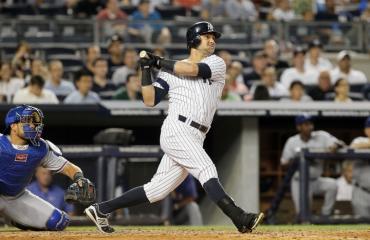
Red Sox Weighing Cody Ross vs. Nick Swisher


The Red Sox are widely reported to have interest in free agent outfielders Cody Ross and Nick Swisher. To follow is an analysis of both players, based on games/dependability, offense, defense, personality/character and price.

The 31-year-old Ross, of course, played on a one-year, $3 million contract for the Sox last season. He performed quite well, posting a .267/.326/.481/.807 line, to go along with 22 homers and 81 RBI.

The 32-year-old Swisher wrapped-up a five-year contract last season, playing out a club option with the Yankees for $10.25 million. He had another terrific season, posting a .272/.364/.473/.837 line, to go along with 24 homers and 93 RBI.

Ross became an everyday player in 2006, Swisher in 2005. So we'll compare the two since the 2006 season.

Since that time, Ross has averaged 124 games per season, peaking at 153 in 2010 after 151 in 2009.

Since 2006, Swisher has averaged 151 games per season, going six straight years playing in at least 150, before dropping to 148 last season.

Advantage: Swisher.

Ross has a career line of .262/.324/.460/.783, with 122 homers, 186 doubles and 452 RBI.

Swisher has a career line of .256/.361/.467/.828, with 209 homers, 251 doubles and 672 RBI.

SPLITS

Ross, career against righties: .253/.312/.415/.727, 64 HR, 278 RBI
Ross, career against lefties: .284/.353/.575/.928, 58 HR, 174 RBI

Swisher, career against righties: .250/.342/.478/.820, 162 HR, 502 RBI
Swisher, career against lefties: .270/.402/.441/.842, 47 HR, 171 RBI

Swisher is switch-hitter.

Advantage: Swisher

Ross can play all three outfield positions and is a solid defender.

Swisher can play left and right field, but is not a great defender. He can also play first base.

Advantage: Ross in the outfield; Swisher for his infield/outfield versatility.

Both players are known as great clubhouse guys with positive, outgoing personalities. Ross endeared himself to Red Sox fans last season with his ready smile and amiable charm. Swisher is a similar sort of guy.

"I think he brought a lot to the Yankees as far as just a free spirit, a little bit of an edge," said ESPN's Tim Kurkjian of Swisher. "And I think he would be good in Boston. I think he would be good in the clubhouse. If I were the Red Sox I would look long and hard at him... I think he's very much on the radar there for the Red Sox, and I think he should be."

Advantage: even

Ross wants a three-year, $24 million deal.

Swisher is looking for a five- or six-year deal. But odds are that he’ll have to settle for four, perhaps at the same $13 million per year that Napoli just got from the Red Sox.

Advantage: Ross

The addition of Swisher would give the Red Sox even more flexibility after adding catcher-first baseman Mike Napoli. Napoli will likely play first base most of the time, but when he catches, Swisher could move to first, which is probably his best position. Swisher would presumably start in right field the rest of the time. That flexibility also works in Swisher's favor.

The Red Sox have plenty of money to play with this winter. The cost of each player is not prohibitive. If money is not a concern, then Swisher seems to be the better choice, largely because of his durability, consistency, greater offensive production, his switch-hitting ability and his capacity to play both corner outfield spots, as well as first base. If Swisher could handle playing in New York, there is little doubt that he can also handle the Boston market.

The advantage of Ross is that he will cost less and be under contract for a shorter term. He is also a better outfielder. Most importantly, perhaps, the Sox know exactly what they have and what they'll be getting with Ross because he spent last season with the team.

The case for Ross is also made stronger by the fact that signing Swisher would cost the Sox their second-round pick (around 40th - 45th) next year. Such compensation is required because Swisher rejected the Yankees one-year qualifying offer. The Red Sox top-ten, first-round pick is protected, however.

The Sox really can't go wrong here. Should they end up with either player, they will be well-served because of it.

The shame is that the Sox won't end up with both Ross and Swisher. The team has the financial capacity to sign both players to fill their corner outfield spots. Instead, they gave Jonny Gomes a two-year, $10 million deal. That seems like an inferior choice and a poor decision.

Who would you rather have — Ross or Swisher?

Saturday, November 03, 2012

The 1986 Boston Red Sox: One Strike Away

Bob Stanley's wild pitch nearly hit Mookie Wilson and blew the Red Sox lead in Game 6.

I still have vivid memories of the 1986 World Series between the Red Sox and Mets and, like most Red Sox fans, was stricken by years of angst due to the outcome. I was watching Game 6 live, in disbelief, as that ball infamously rolled between Bill Buckner's legs.

Until the Red Sox finally won the World Series in 2004, I was never able to re-watch and re-live Buckner's gaffe. It was too painful to view again. Once was more than enough. I'd avert my eyes, change the channel or walk out of the room, if necessary. But the 2004 World Series victory served as a sort of psychic balm that healed all the wounds of Red Sox past.

So, I recently went back and re-examined that notorious Game 6 and was reminded that the Red Sox epic loss was due to a series of cumulative mistakes, not just Buckner's legendary error.

The evidence is abundantly clear: Buckner was by no means the only Boston player at fault for the team's historic meltdown. His mistake is just the most famous and, ultimately, the only one that seems to be remembered after all these years. But that is the result of rather selective memory.

Another thing often forgotten is that Buckner's error, and the Red Sox momentous implosion that October evening, didn't decide the World Series. It was only Game 6, not Game 7. The Sox still had another chance, two nights later, to become Champions. But they couldn't overcome the Mets that night either.

The fabled ball hit to Buckner down the first base side took two hops and then simply rolled beneath his glove. It wasn't a bad hop or a difficult play. It was a rather routine ground ball. Buckner simply made a devastating miscue.

Twelve days before the World Series began, Buckner seemed to have a premonition of what was to come. In a televised interview, Buckner said, "The dreams are that you're gonna have a great series and win. And the nightmares are that you're gonna let the winning run score on a ground ball through your legs."

Honestly. He actually said that to a reporter on camera and the video still exists.

The Red Sox held a 5-3 lead over the Mets in the bottom of the 10th inning of Game 6, and a 3-2 Series lead. Sox closer Calvin Schiraldi recorded two quick outs (fly balls to Wally Backman and Keith Hernandez), leaving Boston just one out away from its first World Series title since 1918.

In the intervening years, the Sox had lost three heartbreaking seven-game World Series' — to the Cardinals in 1946 and 1967, and to the Red in 1975.

Schiraldi was in his third inning of work that fateful evening, something to which he was entirely unaccustomed.

Buckner was also left in the game in lieu of his usual late-inning defensive replacement, Dave Stapleton. Buckner was stricken by gimpy ankles that limited his mobility. In fact, Buckner was the first major league player to wear Nike high-top baseball cleats during games in order to relieve the stress on his ankles.

But, given Buckner's many invaluable contributions throughout that season, Sox manager John McNamara wanted the veteran to be on the field for the final out. It seemed a fitting and well-earned tribute at the time.

By the second out of the ninth inning, Bob Costas and the NBC camera crew were already set up in the visitors' clubhouse at Shea Stadium. The entire Red Sox clubhouse had been covered with plastic in preparation for the champagne and beer-soaked celebration that would shortly ensue.

The Championship trophy was even rolled into the Sox clubhouse.

But fate would quickly intervene.

With two outs and the bases empty, Gary Carter punched a single into left field. At that moment, the left field score board briefly flashed, "Congratulations to the 1986 World Champion Boston Red Sox."

That message proved to be quite presumptuous, and ominous.

The next hitter, backup infielder Kevin Mitchell, lined a pinch-hit single into center. Now there were two men on base, one in scoring position. That brought third baseman Ray Knight to the plate for the Mets.

Schiraldi got two strikes on Knight, leaving the Red Sox one strike away from the cherished World Series Championship that Boston had long been dreaming of. But on the third pitch of the at-bat, Knight swatted the Mets' third consecutive single of the inning, driving in Carter from second and advancing Mitchell to third. The tying run was now just 60-feet away for the Mets.

With the Red Sox clinging to a scant one-run lead, McNamarra made a call to the bullpen. The Sox skipper chose to replace his faltering closer with veteran Bob Stanley, the man Schiraldi had supplanted in that role late in the season.

Meanwhile, the champagne was being readied inside the Red Sox clubhouse. All of MLB's celebratory preparations were well underway.

Mookie Wilson strode to the plate for the Mets with the tying run on third and the winning run on first. Stanley was able to get two strikes on Wilson and once again the Sox were just one strike away from victory. Wilson fouled off a series of pitches, working the count to 2-2. On the seventh pitch of the at-bat, Stanley uncorked a wild pitch that nearly hit Wilson, allowing Mitchell to score the tying run and advancing Knight to second.

League officials quickly removed the champagne and the Championship trophy from the Red Sox clubhouse, while all the plastic was pulled down from the walls and surrounding lockers. Costas stayed behind with just a skeleton crew from NBC.

Somehow, Stanley's blunder is often forgotten. But it was Stanley that blew the Sox precious lead. Until that moment, the Sox were ahead. Even if Boston were to record another out that inning, it would only assure them of getting into the 11th inning and nothing more. The game could no longer be won in the 10th... by the Sox.

Wilson stepped back into the batter's box and worked the count full. On the tenth pitch of the at-bat, he hit a slow ground ball along the first base side. Buckner scrambled to his left and into position to make what appeared to be a routine, inning-ending play. But it was not to be.

After two hops, the ball rolled right underneath Buckner's glove as Knight was rounding third. Seeing the stunning error that had just unfolded, Knight raced home, grasping his helmet to his head with both hands, in total disbelief.

The ebullient Knight scored the game-winning run and the Mets astonishingly seized victory from the jaws of defeat.

Vin Scully's call of the play would become iconic to sports fans.

"So the winning run is at second base, with two outs, three and two to Mookie Wilson. (A) little roller up along first... behind the bag! It gets through Buckner! Here comes Knight, and the Mets win it!"

Scully then remained silent for more than three minutes, letting the pictures and the crowd noise tell the story.

Meanwhile, the NBC camera crew scrambled to break down their equipment and pull all of the TV and audio cables out of the Red Sox clubhouse as quickly as possible.

Four times in that final inning, the Mets were down to their last strike. Yet, the Red Sox couldn't close the deal.

Somehow, Buckner came to singularly symbolize the Red Sox epic failure. Stanley escaped relatively free and unscathed from the dark annals of Red Sox history, as well as from the ire of a legion of Red Sox of fans.

No one seems to remember that it was Stanley's wild pitch that cost the Red Sox their lead. And no one seems to remember that Schiraldi gave up three consecutive two-out singles — allowing a run and putting the tying run on third — rather than closing out the game.

Only Buckner's blunder is remembered after all these years.

Red Sox right fielder Dwight Evans says that after the game, none of the Red Sox players blamed Buckner for the loss or thought it was his fault.

But the fans and the media saw things differently. They needed a scapegoat and a whipping boy. Buckner became both.

The next night's scheduled contest, Game 7, was rained out, leaving Red Sox fans to stew and grow ever more despondent. Losing seemed to be the Red Sox destiny and the team's perpetual bad luck was playing itself out once again on national television. What felt like drama to baseball fans around the nation felt like a kick in the gut to Sox fans.

Boston would stake out a 3-0 lead through six innings in Game 7, only to lose in heartbreaking fashion by a score of 8-5. Once again, Knight was the Mets' hero, hitting the tie-breaking home run in the seventh.

Knight batted .391 with five RBIs and was awarded the World Series MVP for his efforts. He also won the Baseball Writers Association of America's Babe Ruth Award for the best performance in the World Series.

Mets fans were over the moon with joy, reveling in the team's first World Series title since 1969.

Boston fans, on the other hand, were in mourning. The Red Sox were so close to that elusive Championship — one strike away on four separate occasions — yet went down in defeat in seven games once again, just as they had in '46, '67 and '75. It had become a loathsome trend of customary despair.

By that time, pleas of "Wait until next year" had grown oh so trite. The Sox did indeed appear cursed. And Buckner seemed to epitomize that supposed hex.

What's often forgotten is how great a baseball player Buckner was throughout his long career and how significant his contributions were to the Red Sox from 1984 to 1987.

When Buckner finally ended his career, he had won a batting title (1980) and had more hits (2,715) than legends Ted Williams and Joe DiMaggio. He also batted at least .300 in seven seasons.

Yet, all that's remembered is that damn ground ball in Game 6.

The Red Sox acquired Buckner from the Cubs for Dennis Eckersley and Mike Brumley on May 25, 1984. The Red Sox were 19–25, and in sixth place in the American League East at the time of the trade. However, after obtaining Buckner the Sox improved to 67–51 the rest of the way and finished the season in fourth. Buckner invigorated a lackluster Sox squad with some offensive firepower and the will to win.

Buckner appeared in all 162 games for the Red Sox in 1985, batting .299 with 16 home runs and a career high 110 RBIs in the number two spot in Boston's line-up. Buckner was a prototypical contact hitter, and struck out just 36 times in 718 plate appearances to lead the league in that category.

Buckner also led the league in most at-bats per strikeout in '86 and was second in '87. Additionally, Buckner drove in over 100 runs in both '85 and '86.

But after the '86 World Series, Buckner was heckled and booed by his own home fans and even began receiving death threats.

Given all that, it's rather amazing that the Sox had Buckner back in '87 and that he was even willing to return. However, their association didn't last long; the Red Sox released Buckner on July 23, despite the fact that he was batting .273 with two home runs and 42 RBI through 95 games.

Buckner went on to play for the Angels and the Royals from '87 through '89. However, he eventually returned to Boston as a free agent in 1990 for 22 games. Buckner received a standing ovation from the crowd during player introductions at the home opener on April 9. However, the reunion was short-lived; the veteran retired on June 5 after batting just .186 with one home run and three RBI.

Most remarkable of all, perhaps, was that Buckner and his family lived in Boston until 1993, at which point they finally moved away for good. Buckner's wife couldn't stand the heckling and jeering directed toward her husband whenever they were out in public.

Ultimately, after a fantastic 21-year career, Buckner deserves to be remembered for a lot more than a single error. But sadly, just one play stands out in his illustrious career.

A wonderful healing moment finally occurred for Buckner when he returned to Fenway Park to throw out the first pitch to former teammate Dwight Evans at the home opener on April 8, 2008. The game was a celebratory event, with the Red Sox unfurling their 2007 World Series Championship banner.

Buckner received a four-minute standing ovation from the sell-out crowd. It was a beautiful experience for everyone. Buckner was visibly moved and genuinely appreciative of the warm reception he received. At long last, it seemed that he was finally forgiven by Red Sox fans.

Such an occasion was well-deserved and long overdue. Bill Buckner should be remembered for a lot more than just one error.

Bob Stanley, on the other hand... well, that's another story.


Saturday, September 01, 2012

Red Sox Weighing Options With Jacoby Ellsbury

Jacoby Ellsbury has one final year of arbitration remaining before he becomes eligible for free agency, a challenging situation for the Red Sox. Ellsbury was drafted and groomed by Boston, becoming one of the organization's brightest young talents along the way.

Ellsbury stole 50 bases in 2008 and followed that by stealing 70 bags and batting .301 in 2009. Ellsbury looked like a star in the making before his 2010 season was derailed by a collision with teammate Adrian Beltre that broke the center fielder's ribs. Ellsbury was limited to just 18 games that season.

But Ellsbury returned to have a truly breakout season in 2011, batting .321 with 212 hits, 46 doubles, 32 homers, 105 RBI, 119 runs and 39 stolen bases. As a result, he finished second in the MVP voting.

Everyone in baseball was eager to see how Ellsbury would follow up such a breathtaking performance. But after suffering a dislocated shoulder just one week into this season, he was sidelined once again, this time for three months. Again, it was a collision — of sorts — that resulted in Ellsbury's injury, as Rays shortstop Reid Brignac’s knee came down on Ellsbury's shoulder at second base.

Since returning, Ellsbury's performance has been lackluster, at best. In 53 games, Ellsbury is batting just .267 with a .310 OBP — hardly All Star numbers. To make matters worse, Ellsbury has also suffered a power outage, hitting just two homers and knocking in only 16 RBI. At this pace, Ellsbury would compile just 240 total bases over the course of a full season, after posting a league-best 364 last year.

Ellsbury's stunning 2011 performance bears no resemblance to any other season of his career, which is a reason for concern. Ellsbury hit 32 home runs last, year, yet has combined for just 22 homers in parts of six other Major League seasons. In fact, Ellsbury has never even reached double digits in home runs in any other season, and his next highest RBI total is 60. Does one breakout season in six years make a player a bona fide middle-of-the-order hitter?

So just what is Ellsbury's value? That may be hard to determine in the absence of multiple bidders. Yet, the Red Sox surely don't want it to go that route. They have internally established their center fielder's value and won't enter a bidding war to retain his services.

Even before his poor 2011 season and injury-riddled 2012 campaign, Carl Crawford, a similar player to Ellsbury, was never worth $21 million annually. The Red Sox made a huge mistake with that contract and are grateful that the Dodgers took the overpriced Crawford off their hands. Most baseball insiders assume that Crawford's pact will be agent Scott Boras' benchmark in the Ellsbury negotiations.

Long term deals are often looked back upon with regret, at least by the teams that made them. So, with 22-year-old Jackie Bradley Jr. in the pipeline, and likely ready for the big league in 2014, will the Red Sox feel compelled to go all in for Ellsbury?

Perhaps.

Bradley has never played a game above Double-A and is still just a prospect. Plenty of minor leaguers have seemed like can't miss kids, until they missed. It happens all the time. Additionally, the next two free agent classes of center fielders are very thin.

The Sox won't touch Josh hamilton, who is 32, injury prone and has substance abuse issues. Curtis Granderson will be in Elllsbury's free agent class, but does anyone believe the Yankees will lose one of their own highly-coveted players? Have the Yankees ever been out-bid?

One thing is for sure, Ellsbury won't come cheaply. The question is if he'll be worth all that money.

Boras says his client is a franchise player and seems determined to let the market determine Ellsbury's value after the 2013 season. Gordon Edes writes that the Red Sox have privately discussed offering Ellsbury a contract extension this winter and plan to at least make an attempt to keep him from hitting the open market next year.

However, given Boras' history of letting the market determine value, it's unlikely he would encourage Ellsbury to sign an extension with Boston this winter.

With that in mind, is it best for the Red Sox to trade their center fielder this offseason, or to keep him and let him play out the 2013 season?

Ellsbury turns 29 on September 11th, and will be 30 when his arbitration eligibility expires after next season. Will the Red Sox engage in a six to eight-year deal with a player of that age, especially after misfiring on a number of long term deals in recent years? After all, Boras will surely be seeking a contract of that length for Ellsbury.

Ellsbury will make $8.05 million this season and arbitration always seems to mandate a raise for players — even when they don't deserve it. So the Red Sox can retain Ellsbury on a reasonable one-year deal, perhaps in the vicinity of $10 million. That's chump change to the Sox, who are suddenly flush with cash.

Keeping Ellsbury around next season could be a wise idea since he will be particularly motivated to increase his value heading into free agency. It's uncanny how many players have career-years leading into free agency.

Additionally, since the Sox just dealt Crawford and Adrian Gonzalez, the Sox may need Ellsbury more than ever next season. Without Ellsbury, the Sox offense would take an even more giant leap backward.

However, under baseball's new collective bargaining agreement, teams no longer receive two compensatory draft picks when their top free agents leave; they will now receive just one — as long as they offer a qualifying, guaranteed, one-year contract. The compensatory pick will be sandwiched between the first and second rounds. There are no longer distinctions between Type A and Type B free agents.

That could make Ellsbury less valuable to the Red Sox than he would have been in the past.

A team will have to offer its own free agents the average of the top 125 contracts — currently about $12.4 million — to receive draft-pick compensation if their former player signs with a new team. Given that Boras will be seeking an average annual salary for Ellsbury exceeding that amount, it's a no-brainer that the Sox will make such an offer if Ellsbury is still with the team at the end of next season.

Additionally, only players who have been with their clubs for the entire season will be subject to compensation. This would make Ellsbury particularly attractive and valuable to other teams this winter. If he is traded at the deadline next July, the acquiring team would receive no compensation if Ellsbury left via free agency.

The Red Sox have surely made an internal determination of Ellsbury's value. The key now is to decide which is greater; one more year with Ellsbury in center and the middle or their order, or the return they might get for him in a trade.

The guess here is that there is more to be gained by hanging onto Ellsbury and hoping for another MVP-worthy season in 2013. Yes, Ellsbury's 2011 performance may have been an outlier, the likes of which he'll never repeat. But considering his affordability next year, and the fact that the Red Sox can easily make him a guaranteed qualifying offer for 2014 that would at least secure a sandwich pick in the 2015 draft, it seems to make the most sense to hang onto Ellsbury instead of trading him.

Unless the Mariners are offering Felix Hernandez. In that case, the Red Sox can't act quickly enough to make it happen.

Sunday, August 26, 2012

Rebuilding the Red Sox Will Be Painful and Require Patience

Once the thrill of dumping $260 million in salary and reducing next year's payroll commitment to $38.8 million from $99.6 million wears off, the reality will set in. The Red Sox aren't likely to be a good team again for a few years. How long before they become a legitimate World Series contender is anybody's guess.

The Red Sox still have a fine group of young players that will comprise their core for the next few years: Dustin Pedroia, Will Middlebrooks, Ryan Lavarnway, Ryan Kalish, Jarrod Saltalamacchia, Felix Doubront, Franklin Morales, Jon Lester, Clay Buchholz and Andrew Bailey. Perhaps even Jacoby Ellsbury (if the Sox can work out a long term extension with Scott Boras this winter) and Mike Aviles will be a part of that core.

The Sox can only hope that most of their prized prospects (including those acquired from the Dodgers in Friday's epic trade) pan out as projected. But that will require all of the stars and planets to align correctly.

The Red Sox spent $175 million this season and failed miserably. They shouldn’t need a $150 million roster to win a championship. They need motivated, determined players with a fighting spirit, a positive attitude and a commitment to teamwork in order to succeed.

The trade with the Dodgers had to happen, and the Red Sox are quite fortunate that it did. What was the point of having so many high-priced, under-performers on the roster? The Sox can just as easily finish in fourth or fifth place without those players, yet save the enormous associated costs. This team was going nowhere with the players who were traded, and it couldn't possibly rebuild with them on the roster.

So, now that process can begin. But it will take a few years before Boston is once again a competitive team, in my estimation.

Red Sox fans will have to be patient, and I think they will be. I think they'd rather root for a team of young, homegrown talent that tries and fails, rather than the sort of team that let them down this year and last.

The Red Sox will not follow their previous path to failure. Signing lots of high-priced free agents didn't work for them over the past decade and management is well aware of that. Boston won't touch Josh Hamilton. The guy is 32 and has way too many problems.

Going forward, I think the Sox will rely more on trades than free agency. Free agents are invariably older, often on the wrong side of 30, and already have at least six years of major league experience. The Sox would rather trade for younger players in their peak years — the mid-to-late 20's — who are still just arbitration-eligible. Then the organization can sprinkle in the appropriate, prized free agents here and there.

But that rebuilding process will take some time, which is not something that most baseball executives or Red Sox fans could have imagined over most of the past decade.

Though they won two Championships in a four-year span — the last of which was just five years ago — the Red Sox have intermittently experienced off years. However, they've have now endured three of them in succession. The Sox haven't won a playoff game since 2008 and they haven't even made the playoffs since 2009. So, Red Sox fans already know what it feels like when their team underperforms and disappoints.

However, this proves that the Red Sox are not exempt from the ups and downs of the sports cycle. There will indeed be down periods. Only the Yankees seem immune to this and are able to continually reload. That's simply amazing.

The best news for the Red Sox is that they appear to have some good players in the pipeline who are just a couple of years away. And now they also have tremendous financial flexibility, which seemed unimaginable just 72 hours ago.

The front office will improve this team during the offseason, I have no doubt. If there are free agents that fit and make sense in Boston, the Red Sox will pursue them. However, they are not done dealing either. It would hardly be surprising to see Ellsbury traded this winter.

The Red Sox have successfully traded four of the nine players signed to guaranteed contracts beyond 2012. In the process, the Sox unloaded their three biggest contracts, as measured by average annual value. The team has quickly gone from $99.6 million in guaranteed money to just $38.8 million.

That can only be viewed as a positive, and amazing, orchestration by the front office.

If this team is destined for some lost years, better to endure them while rebuilding for the future with homegrown talent, and doing it on the cheap.

That's preferable to watching spoiled millionaires act as if they are entitled to not care, or even make an effort.

Saturday, August 25, 2012

Epic Trade Remakes Red Sox Roster, Restores Hope


To say that this season hasn't gone the way the Red Sox or their legion of fans had anticipated is an understatement. With a roster full of former All Stars costing $175 million this year alone, the Red Sox woeful 60-66 record and tepid individual performances are monumental disappointments. Burdened by a roster full of entitled underachievers, the Red Sox simply are not a likable club.

The team seems to have just given up and thrown in the towel on an already miserable season.

Going into Friday's contest, the Sox were 6-15 in August. They had lost four straight and 11 of 15. They were 29-37 at Fenway Park this season and had lost nine of their last 11 games there. The once-mighty Red Sox were 16-21 since the All Star break.

Playing sub-.500 baseball has become a way of life for the lackluster Red Sox over the last calendar year.

This club lacks chemistry, heart, desire and will. They are simply an abysmal bunch, given the huge payroll and high expectations.

Boston is on pace to finish with a losing record for the first time since 1997. Considering the high-level talent on the roster and the money committed by ownership, that is simply unacceptable.

However, it seemed that there was nothing the Red Sox could do about their roster until the offseason, at least. Even then, there was a strong chance that they were just stuck with a series of really bad, long-term contracts doled out to disinterested players.

What team in baseball would want Josh Beckett's bad attitude, bad back, dubious shoulder and 90 mph fastball? Who would take the passionless, aimless Carl Crawford and his newly repaired left elbow?

Becket is owed nearly $32 million over the next two seasons and Crawford is owed more than $100 million over the next five. Both players and their contracts seemed virtually unmovable. For guys making so many millions, simply for playing a game, both seemed miserable. Had anyone seen either player smile in the last two years?

The Red Sox appeared stuck.

Then, quite suddenly, along came the Los Angeles Dodgers with an answer to the Red Sox prayers.

Goodbye Beckett. Goodbye Crawford. Goodbye Adrian Gonzalez. And goodbye Nick Punto, a guy known for nothing more than taking up space and destroying his teammates shirts. Thanks for nothing fellas, you're the Dodgers problem now.

Good riddance.

In one fell swoop, GM Ben Cherington has put his stamp on this team and freed up roughly $260 million in payroll. Think about that for a moment; that's more than a quarter-of-a-billion dollars. John Henry must be dancing on a table inside his yacht, drinking champagne straight from a magnum.

The fact that Cherington was able to send three absolutely massive contracts to a single team — and only have to kick in about $10 million in the deal — is stunning. The GM's behind-the-scenes machinations can only be viewed as a coup de tat.

Additionally, the Red Sox will be free of Kevin Youkilis' $12 million salary and Daisuke Matsuzaka's $10 million salary at season's end. At that point, the club will finally be rid of virtually all their bad contracts, save for John Lackey's.

Think the Dodgers could again be fooled into taking another Texas Trouble-Maker? After all, Lackey really seemed to love Southern California.

From the Red Sox perspective, this deal with the Dodgers is nothing more than a salary dump. The prospects (Allen Webster, Rubby De La Rosa, Ivan DeJesus and Jerry Sands) are just gravy. One never knows how prospects will pan out. Does anyone remember how good Lars Anderson and Michael Bowden were going to be?

If the two pitchers (Webster and De La Rosa) turn out to be as good as projected, it will only make this salary dump all the better.

Now the Red Sox can go back to focusing on developing homegrown talent. Xander Bogaerts, Bryce Brentz, Matt Barnes and Jackie Bradley Jr. (the Killer B's) are all just a couple of seasons away from the Show.

If you are a Red Sox fan, you have to feel a lot better about this team and this organization today than you did 24 hours ago. And for that, we can all feel grateful

Thank you, Ben Cherington. You are not tone deaf after all. You were really listening to the fans and seeing what the rest of us were seeing.

Now we can go back to rooting for this team again. Better days are surely ahead.

Monday, August 06, 2012

Bobby Valentine Is Not The Reason For Red Sox Failure

John Henry released a statement this afernoon backing manager Bobby Valentine and saying the skipper's job was safe. Henry noted that, "Baseball managers often get too much credit and too much blame for what happens on the field."

Whether Valentine's job is safe after this season ends is open to much speculation and he may, in fact, be terminated in the fall. The Sox brass gave Valentine a brief window of opportunity when they handed him a two-year deal last winter, which wasn't a vote of confidence.

Perhaps Valentine won't see year-two in Boston, but the Red Sox failures this season cannot be laid at his feet.

Red Sox starters have a cumulative ERA of 4.78, 11th out of 14 AL clubs. Boston's top-three starters — Clay Buchholz, Josh Beckett and Jon Lester — have ERAs of 4.48, 4.54 and 5.36, respectively.

If you're looking for the reason the Red Sox have been a .500 ball club all season, look no further. Yet, there's more.

The feast or famine Red Sox have scored the third-most runs in the major leagues, more than the first-place Yankees. Yet, the Sox have been limited to two or fewer runs 29 times. That's not Bobby Valentine's fault.

A whole host of high-priced veterans that this team was counting on when the season began are all having off years at the same time. But that's not all.

Red Sox players have missed 1,119 games while on the disabled list. That's mind-boggling.

The Sox have set a team record by putting 23 players on the disabled list 27 times this season. The 23 players on the DL are the most in a single season by any team in the majors since 1987.

None of that is Bobby Valentine's fault either.

More than anything, the Red Sox really need a roster overhaul. However, they have a number of overpaid under-achievers bogging down their roster, which are always the hardest players to move.

John Lackey will be back in the rotation next season, in lieu of Aaron Cook. However, all four of the other current starters will almost certainly be back in 2013 as well. That's the same group that isn't getting it done this year.

The Sox appear to be handcuffed to Beckett, which is most unfortunate.

In his seven seasons in Boston, Beckett has produced an ERA under 4.00 just three times. And he has twice had an ERA over 5.00. This is the guy who was supposed to be the staff ace from the very beginning, and whom the Red Sox handed a four-year, $68 million extension before the 2010 season.

Beckett responded by turning in a career-worst 5.78 ERA that year.

Bobby Valentine did not give Josh Beckett that regrettable four-year extension.

Firing the manager would merely be an act of scapegoating. The Red Sox face far bigger, far more important personnel decisions and are saddled with some really bad, long-term contracts that will haunt them for years to come.

John Henry and Co. have a major PR problem on their hands. Fans just don't like this team of high-priced, under-performing veterans.

Ratings on NESN are down and ticket sales are dwindling. Maintaining this phony sellout streak has become a bad joke. Fans arrive late and leave early. Season ticket holders can't resell their seats online. Interest in this team is clearly declining.

If management can't fix the glaring problems it has with its on-field personnel, then perhaps they'll make a clumsy public charade of trying to fix their problems by firing Valentine instead.

But doing that won't address the Red Sox real problems, which are all over their roster.

Wednesday, July 18, 2012

Jon Lester Is Not An Ace

At 28 years of age, Jon Lester is in his prime. At least, he should be. Yet, Lester is having a miserable season, in which he can't seem to do anything right. Lester shows no signs of being the pitcher he once was from 2008 to 2010, when he posted a cumulative 3.29 ERA, 1.23 WHIP and was among the game's best lefties.

In each of those three seasons, Lester pitched at least 200 innings and he struck out at least 200 batters in two of them.

Yet, even before then, much was expected of Lester, a lefty who showed so much poise and promise.

After his 2006 rookie season, in which he threw 81.1 innings and went 7-2 with a 4.76 ERA, Lester was diagnosed with non-Hodgkins lymphoma. Red Sox Nation held its collective breath hoping for good news. This was just a kid at the very beginning of a promising career.

Thankfully, Lester fully recovered.

Following successful treatment, Lester returned to the Red Sox midway through the 2007 season. HIs comeback was highlighted by a dramatic Game Four World Series clincher against Colorado, in which Lester pitched 5 1/3 shutout innings, giving up three hits and three walks while striking out three.

Lester became just the third pitcher in World Series history to win the series clincher in his first post-season start.

The Red Sox had a 23-year-old lefty who would be in their rotation for years to come, who had already pitched on the biggest stage and who had performed admirably. Things were looking up for Lester and the Red Sox.

In 2008, Lester went 16-6 with a 3.21 ERA and threw a no-hitter at Fenway Park. The Sox seemed to have their future ace. In each of the next two seasons, Lester continued to build on his success and established himself as one of the top young lefties in baseball.

But last season, things began to unravel for Lester, and that process has accelerated this year. Though he was named to the All Star team for the second consecutive season in 2011, and led the Boston rotation in wins and strikeouts, Lester took a step back. The lefty won 15 games but failed to reach 200 innings for the first time in four seasons and failed to strikeout 200 batters for the first time in three seasons.

When the Red Sox needed Lester to step up in September and be their ace, he failed to do so. Lester lost his last three starts and was never a stopper as the Red Sox wildly spun out of control. The team posted a 7-20 record that month, a historic collapse for a team that had been in first place for much of the season.

This year, Lester picked up right where he left off last September, showing futility far too often.

The Red Sox are 7-12 in Lester's starts this season. Lester got rocked again last night, lasting just four innings. It was the fifth time this season that he has not made it to the fifth inning. The lefty has not lasted past the seventh inning since May 14. Over his last two starts, Lester has given up 10 earned runs on 16 hits in 8 1/3 innings.

Think about that; the Red Sox have lost 12 of Lester's 19 starts. It's mid-July and he has a 4.80 ERA. In nine of Lester’s starts, he has either lost a lead or allowed a run to break a tie. That's your No. 1 starter, folks.

This is the guy that has been chosen as the Opening Day starter for two seasons running. He's the guy who had previously shown so much promise, potential and hope. He's the guy upon whom the Red Sox thought they could depend, on whom they placed so much responsibility. And Lester has failed to respond positively. When called upon, he repeatedly cannot answer the bell.

If he remains healthy, Lester should have about 14 more starts this season. If he somehow manages to average six innings per start in that stretch (which is not a given considering his performance this season), Lester would tack on another 84 innings to the 116.1 he already thrown this season. That would put him squarely at 200 in 2012. It could also prove to be the highlight of his season.

It should be noted that though Lester has been viewed as an ace and as the Sox No. 1 starter, there have always been questions about that status.

Yes, Lester threw the no-hitter. But some rather unremarkable pitchers have also done that. Just in the past decade alone, Anibal Sanchez, Jonathan Sanchez, Ubaldo Jiminez, Dallas Braden, Edwin Jackson, Francisco Liriano and Phil Humber have all thrown no-hitters. That's not exactly a who's who list, or a group of future Hall of Famers.

The point is, even an average pitcher can have a spectacular game, the likes of which becomes his career highlight. That's not to say that Lester is average, but make no mistake; pitching a no-hitter doesn't make someone a star or an ace. Pedro Martinez, Greg Maddux, Roger Clemens, Steve Carlton, Grover Alexander and Lefty Grove, for example, never threw a no-hitter in their illustrious careers.

Lester has never won 20 games in any season. In 2010, he had 19 wins going into his final start of the year. In that big moment, instead of stepping up and winning his 20th game for the first time — for himself and his team — Lester melted down. He lasted just four innings, giving up a whopping eight runs on nine hits and five walks. Lester folded in a big moment, a chance at a personal milestone. And a victory would have given the Red Sox 90 wins that season.

Winning 20 games one season does not make a pitcher an ace. But it looks good on the resume and it helps make the argument a little stronger. Most aces win 20 games in multiple seasons.

Moreover, Lester has never won an ERA title or a strikeout crown either. If he wants to be thought of as an ace, he needs to win at least one of those. A couple of each and a few 20-win seasons would solidify the argument.

Let's be honest; Lester is not in the same category as Justin Verlander, Felix Hernandez, Clayton Kershaw, Matt Cain, Roy Halladay, Jered Weaver, David Price, CC Sabathia, Cole Hamels and on and on. Those guys are all bona fide aces.

Lester is not an ace and he has never even been an elite pitcher. He has been a very good pitcher and in most seasons would have been a No. 2 starter on most staffs. This season, he looks like a back of the rotation starter — at best.

In fact, instead of sending Franklin Morales ( 3-2 in five starts, 10 earned runs, eight walks, 31 Ks in 26 1/3 innings) back to the pen, wouldn't it truly be in the Red Sox best interests to send Lester instead?

Monday, July 09, 2012

Red Sox Mired in Mediocrity

Major League Baseball has reached it's recognized mid-point, the annual All Star break. In reality, more than half the season is already over. After playing 86 games, the Red Sox are a .500 team with a 43-43 record. There are 76 games yet to be played in 2012.

Boston limps into the break having lost eight of their last 11 games. At this point, they look totally lost. It hardly comes as a surprise.

The Red Sox have been a middling ream for most of the season — other than those times they've been just plain bad. As the saying goes, water always finds its level. So do sports teams.

In April, the Sox had a five-game losing streak, followed by a six-game winning streak. They finished the month with an 11-11 record and never broke .500.

The Red Sox started May with a five-game losing streak and later posted a five-game winning streak. The Sox were as many as seven games below .500 in May and didn't get back to .500 until May 21. It took them until May 29 to break above .500 and they finished the month just one game over .500. Their May record was 15-14.

The Red Sox endured a four-game losing streak in June, followed by a four-game winning streak. The team got as many as three games over .500 in early June, but quickly fell three games below once again. Toward the end of June, the Sox again worked their way back to five games above .500, their high-water mark for the month and the season. The Sox posted a 15-12 record in June.

The team started the month of July five games over .500. But they immediately proceeded to lose five consecutive games, again reverting to the break-even mark in the span of just one week. So far this month, the Sox are an abysmal 2-6.

This is hardly what Red Sox ownership was expecting from a team that had an Opening Day payroll north of $175 million — the third highest in baseball, following the Yankees and Phillies.

Yes, the Red Sox have been plagued by injuries, losing their projected closer Andrew Bailey and left fielder Carl Crawford before the season even began. Jacoby Ellsbury was lost just two weeks into the season and hasn't played since.

At various points this season, Kevin Youkilis, Dustin Pedroia, Cody Ross, Ryan Sweeney, Scott Podsednik, Will Middlebrooks, Rich Hill, Andrew Miller, Daisuke Matsuzaka (twice), Aaron Cook, Clay Buchholz and Josh Beckett have all spent time on the disabled list.

Despite their depleted roster, amongst all Major League teams, the Red Sox are sixth in batting, fifth in OPS, fourth in slugging, third in hits, third in total bases, second in runs and first in extra-base hits.

Clearly, offense is not the Red Sox problem. The returns of Ellsbury and Crawford will hardly make a difference.

From the very beginning, starting pitching has been this team's Achilles' heel.

Red Sox starters have a 4.81 ERA, third worst in the American League. And Sox starters also have a 1.38 WHIP (walks, plus hits, per nine innings), the fourth worst in the AL.

The Red Sox were counting on big time performances from the trio of Jon Lester, Josh Beckett and Clay Buchholz this season. What they've gotten instead are big time busts.

Lester has 5-6 record to go along with a 4.49 ERA and 1.35 WHIP. That's simply unacceptable. But what are the Sox to do? How valuable is he right now? Does anyone truly believe that other teams will be beating down the Red Sox door to obtain Lester after his September collapse and total failure this season?

Lester has now established a long trend of incompetence going back to last season and it has really hurt his value to the Red Sox — whether he stays with them, or if they seek to trade him.

Beckett is 4-7 with a 4.43 ERA and a 1.20 WHIP. He us under contract for $15.75 million per season through 2014 and as a 10/5 player (10 years in the majors, five with his current team) can veto any trade. If the Sox are successful in any attempts to deal Beckett, they will be paying a substantial portion of his salary to pitch for another team, perhaps even against themselves. This has to be terribly frustrating to the Sox front office.

Buchholz leads the Sox in wins, but his 8-2 record is misleading. HIs run support average of 9.96 is the second best in the majors, after his teammate Felix Doubront (10.59). And Buchholz has a miserable 5.53 ERA and 1.54 WHIP. On another team, he might not have a win this season.

For his part, Doubront has been a pleasant surprise this year. Though his 9-4 record is the product of that aforementioned MLB-best run support, Doubront has fanned 97 batters in just 96 innings this season. That's a strikeout ratio of 9.09, 10th best in the majors.

However, the other side of the coin is Doubront's 4.41 ERA and a 1.38 WHIP. And then there's the question of durability and stamina.

After missing almost all of last year, how much does Doubront have left in the tank for the second half? As it stands, Doubront averages just 5.65 innings per start, putting pressure on the bullpen.

Doubront pitched a career-high 129.1 innings back in 2008, which was five seasons ago. Between the majors and minors, Doubront threw 105 innings in 2010 and just 87.2 last year. Against that backdrop, Sox executives clearly have to be asking how much further he can go.

As good as some of their recent starts have been, can the Red Sox really stake their season on the likes of Aaron Cook and Franklin Morales? Not likely.

The reality is that the Red Sox cannot be a contender without an ace, and they will be hard pressed to acquire one before the deadline. Considering their swings and misses in the free agent market in recent years, will the Sox get in on the bidding for Cole Hammels? It will cost them dearly in terms of prospects, and then there will be a massive long term contract obligation as well.

While Red Sox fans would love to see the club purge itself of all its overpaid, underachievers, those are exactly the types of players that other GMs aren't looking to acquire at the deadline. Every team has scouts and a player's stats are public knowledge. There isn't a team in baseball that thinks that Lester, Beckett or Buchholz will be their difference-maker in the second half. The same goes for Adrian Gonzalez and Carl Crawford.

Fans may be eager to trade players like Ryan Sweeney and Scott Podsednik for a pitcher, but both have limited value. Even Jacoby Ellsbury's value has fallen at this point.

Ben Cherington may get creative and offer a package of players in return for a front line starting pitcher the Sox can control for the long term. But it will likely cost them some combination of major league talent like Lester, Ellsbuury and Cody Ross, plus prized prospects such as Ryan Lavarnway, Xander Bogaerts, Anthony Ranuado and Matt Barnes.

However, if management is of the same view as many of us — i.e., this season is lost, cannot be salvaged and is merely another bridge year to younger, homegrown talent that can meaningfully contribute down the line — we will likely watch the Sox continue to tread water and disappoint their fan base in the second half.

The Red Sox have spent the better part of the past decade building a winning brand in Boston and their fans have come to expect excellence. Given the high ticket prices and player salaries, is it any wonder?

However, the Red Sox have missed the playoffs for two consecutive seasons and have not won a playoff game since 2008. Unfortunately, those marks of futility are likely to be extended again this year.


Tuesday, July 03, 2012

Red Sox Rolled the Dice on Matsuzaka and Came Up Short

So much was expected of Daisuke Matsuzaka when he arrived in Boston that perhaps he was destined to disappoint. But no one ever expected this level of futility.

After all, Dice-K was a six-time All Star in Japan and was crowned the MVP of the inaugural World Baseball Classic in 2006. He also led his league in strikeouts four times, wins three times and ERA twice.

That pedigree led the Red Sox to bid $51,111,111.11 just for the right to buy Matsuzaka out of his Japanese contract and to attempt to sign him to a major league deal. The enormous figure — two to three times the Lions' payroll — shocked the baseball world, from Japan to the U.S.

The Sox then spent an additional $52 million to sign the Japanese righty to a six-year contract. The deal was negotiated on Red Sox owner John Henry's private plane en route from Southern California to Boston. As a sign of the Dice-K mania to come, the flight was followed by both the Boston and the Japanese media.

Matsuzaka arrived in Boston like rock star. He had his own entourage, including a massage therapist, physical therapist, interpreter and personal assistant. He also had an enormous flock of Japanese media that followed him wherever he went in his first spring training, as well as at every game that season.

Matsuzaka was said to possess up to seven pitches, including the infamous "gyro-ball". It appeared he had the stuff to be an ace, and he had certainly cultivated that pedigree in international competition.

But his tenure in Boston hasn't gone anything like Red Sox executives or fans had hoped.

In 2007, his first year with the Sox, Dice-K was a bit of a mixed bag, going 15-12 with a 4.40 ERA and a 1.32 WHIP. Matsuzaka allowed 8.4 hits and 3.5 walks per nine innings. Those numbers were signs of what was to come in subsequent years.

The upside was that Matsuzaka made 32 starts in 2007, threw 204.1 innings and struck out 201 batters.

Clearly, wins and losses are team stats. But given the fact that Matsuzaka had an advantage over hitters who were seeing him for the first time that season, losing 12 games was a surprise. That said, the greater concerns were his high ERA and WHIP.

However, Dice-K helped the Red Sox win the World Series that season. He was expected to improve as he acclimated to life in the Major Leagues and the U.S.

All was well... we thought.

In 2008, Dice-K had by far his best year with the Red Sox, going 18-3 with a 2,90 ERA. But those numbers, while impressive, overshadowed some more troubling stats. For example, Matsuzaka made just 29 starts and threw only 167.2 innings. The latter was a byproduct of the righty's typically short outings.

Matsuzaka's innings per start dropped from 6.4 in 2007 to just 5.8 in 2008. He was undermined by high pitch counts and a lack of command that led to 94 walks, fourth highest in the Majors.

The striking reality lurking beneath the flashy 18 wins was this: Dice-K threw the fewest innings of any pitcher to have ever won at least 18 games in the history of baseball.

The following year, a pattern of injuries began to set in, which became a recurring theme over the remaining four years of Matsuzaka's Red Sox contract. He made just 12 starts in 2009; 25 in 2010; eight in 2011 and just five this season.

Over the last four seasons (2009 - 2012), Matsuzaka is 16-18 with a 5.17 ERA, a 1.49 WHIP, a 1.72 strikeout-to-walk ratio, and zero complete games. This is the guy that was supposed to be an ace, a Japanese wizard of pitching. Go figure.

Matsuzaka never seemed to trust himself or his defense. He wouldn't challenge hitters and attack the strike zone. Instead, he nibbled at the corners and threw too many pitches to each batter. All too frequently, he succumbed to high pitch counts early in games, often by the fifth inning.

For their $103 million investment, the Red Sox got a total of 49 wins over six seasons; an average of 8 wins per season. In six years, Dice-K gave the Red Sox exactly one complete game.

Matsuzaka was never worth all that money, or all the hype that accompanied his arrival in Boston.

Dice-K went on the disabled list once in 2008 (tired shoulder), twice in 2009 (weakness in his throwing arm) and then missed most of 2011 and 2012 due to Tommy John surgery.

Now he is back on the DL yet again — for the eighth time in his six-year carer — with an injury to his trapezeus muscle.

It is possible, though not certain, that we have seen the last of Daisuke Matsuzaka in a Red Sox uniform. Most Sox fans can only hope. However, in the second half of the season, the Sox will likely need pitching depth.

Lefty Felix Doubront threw a total of 87.2 innings last season and is already up to 89.2 this year. Clay Buchholz threw just 82.2 innings last year and is already up to 86.1 this season. Franklin Morales started the season in the bullpen and has made three starts. The last time he made more starts in the majors was in 2008, when he made five.

The point is, the Sox may well need Dice-K again at some point this season.

And that is a very scary prospect.


Monday, June 25, 2012

Red Sox Made Wise Move in Trading Kevin Youkilis


As sad as it was for Red Sox fans to watch Youk go, it was time.

Kevin Youkilis will certainly be missed by Red Sox fans. But there is no doubt that the time had come to trade him. Will Middlebrooks could be the AL Rookie of the Year and he needs to play every day.

Youkilis, who could become a free agent at season's end, has missed extensive time in each of the last four seasons. The Red Sox held a one-year option at $13 million (with a $1 million buyout) for 2013, and they clearly had no intention of exercising it. One way or another, Youkilis was not going to be a member of the Red Sox next season.

At 33, Youkilis isn't aging well and appears to be in decline. Most scouts who've observed him have drawn the conclusion that, though he can still hit, he is now past his prime. This is clear from reports that the White Sox were the only club in the trade talks that didn't insist on the Red Sox picking up all of the remaining $6.6 million on Youkilis' 2012 contract, plus the buyout for next season.

It's a good bet that Youkilis can still be a productive hitter. But it appears that he has peaked and will never again be the player who posted consecutive seasons with an OPS of .950 or better from 2008 to 2010. Years of injuries have caught up to him and taken quite a toll. One has to be on the field to be productive.

Additionally, Youkilis has lost defensive range at third base and, at this point in his career, is best suited to play first. With the emergence of Will Middlebrooks (who leads AL rookies with 34 RBI) at third base, and with Adrian Gonzalez manning first, Youkilis no longer fit in Boston.

Youkilis was never the fastest, the strongest or the most graceful player on the team, or even at his position. But he always had great hand-eye coordination (as evidenced by his 20/11 vision) and terrific instincts. However, as his body has broken down in recent years, even those qualities couldn't make up for what Youkilis was losing physically.

Over parts of nine seasons with the Red Sox, Youkilis batted .286 with 133 HR, 563 RBI and .388 OBP. In that period, Youkilis won two World Series titles ('04 & '07), was a three-time All Star ('08, '09, '11) and was the Hank Aaron Award winner in 2008. That award is given annually to the players selected as the top hitter in each league, as voted on by baseball fans and members of the media.

The Red Sox drafted Youkilis in the eighth round of the 2001 amateur draft. He turned out to be the classic over-achiever. Despite not having a true athlete's body, Youkilis was able to wring every bit of potential from himself by sheer force of will.

Youkilis was called "roly-poly" by his high school coach, "pudgy" by his college coach, a "fat kid" by A's general manager Billy Beane, and a "thicker-bodied guy" by the Red Sox scout who recruited him.

However, Red Sox fans truly appreciate hard-working, dedicated ballplayers, regardless of their physical limitations. Youk was the quintessential "Dirt Dog"; a player whose grit and hustle always seemed to result in a dirty uniform.

In fact, Youkilis' hard-nosed style of play may have been his downfall. Due to assorted injuries, Youkilis has not played in more than 136 games for four consecutive seasons. That's nearly half his tenure in a Red Sox uniform. From 2009 to 2011, Youkilis averaged just 119 games per season.

Once again — due to injury, but also due to the emergence of Will Middlebrooks — Youkilis played in just 41 of a possible 72 games this season.

Even if Youkilis plays in every one of the White Sox remaining 90 games this season (which seems highly unlikely), he would ultimately play in a total of just 131 games this year. This trend will surely hurt his value on the free agent market this winter. But it's not the only red flag.

After posting a .258 batting average last season, Youkilis is batting just .225 with a .311 on base percentage this year. The latter is particularly troubling since Youkilis had previously posted an OBP of at least .400 in three seasons and of at least .390 in five seasons.

These are disturbing trends for a player who had been so consistent, and so good, from 2004 through 2010.

Youkilis was named to the Sporting News' list of the 50 greatest current players in baseball three times, ranking No. 36 on the list in 2009, No. 38 in 2010, and No. 35 in 2011.

Yes, as amazing as it seems, Youkilis was ranked the 35th-best player in baseball just one year ago; how far he has fallen since then.

Youkilis played for the Red Sox during a historic period of the team's history, in which they won at least 90 games six times in an eight-year stretch, spanning from 2004 to 2011. The Sox also qualified for the postseason five times during Youkilis' tenure, winning the World Series twice in that frame.

If not durable, Youkilis was indeed versatile, switching from third base to first in 2006 to accommodate the arrival of Mike Lowell. All Youkilis did was win a Gold Glove in 2007 and break Stuffy McInnis's club record of 120 consecutive games at first base without an error, set in 1921. Youkilis's streak at the end of the regular season was 190 games. He led the league with a perfect 1.000 fielding percentage, and an AL-record 1,079 error-less chances at first.

On April 2, 2008, on an unassisted game-ending play against the Oakland A's, Youkilis broke the Major League record for most consecutive error-less games by a first baseman, previously held by Steve Garvey, at 194 games. In his 205th game without an error on April 27, Youkilis also established a new major league record for first basemen, when he fielded his 1,701st consecutive chance without an error, passing the old mark of 1,700 set by Stuffy McInnis from 1921 to 1922. His streak, which started on July 4, 2006, was snapped at 238 games (2,002 fielding attempts) on June 7, 2008 against the Seattle Mariners.

Youkilis may have three or four more productive years left in him, but he'll have to switch back to first base to make the most of them. The grind of playing third every day will wear him down and his lack of range will result in routine plays not being made.

At some point after his retirement, it's a safe bet that Youkilis will be inducted into the Red Sox Hall of Fame. He was a beloved player who excelled during a very special era of winning baseball in Boston.

Youkilis was also a very productive member of the Red Sox, as his statistics will attest:

His .388 OBP is 11th in club history; his .875 OPS is 11th; his .487 slugging percentage is 12th; his 133 home runs are 18th (tied with Trot Nixon); his 239 doubles are 19th; his 564 RBI are 21st; his 594 runs are 25th; his 961 hits are 31st; and his .286 average is 32nd amongst Red Sox players.

But let's be clear; none of Youkilis' stats are top-ten in Red Sox history, and it took him nine seasons to compile them. He doesn't have another nine years in him and even if he did, he wouldn't double his previous production. The point is, the Red Sox had Youkilis during his prime years, his most productive years. He gave the Sox everything he had to give and they got a relative bargain in the process.

Youkilis' $424,500 salary in 2007 was the fourth-lowest on the club. And he earned $3 million in 2008, a year in which he finished third on the AL MVP ballot. The Sox got a lot of value for the cost. Youkilis didn't sign his first big contract — a four-year, $41.25 million deal — until 2009. Unfortunately, that's when the injuries began to mount and the production began to fall.

Will Middlebrooks is under Boston's control until 2017. He will be quite affordable for the big-market Red Sox at least until that time. If he stays healthy, all indications are that Middlebrooks can be every bit as good as Youkilis. The key is that Middlebrooks is ten years younger.

Time isn't kind to most athletes. In the era of free agency, players change teams every few years and team rosters turn over over few years. There are always young players waiting to take a veteran's spot. David Ortiz is now the only remaining member of the 2004 World Series team.

Red Sox Nation will always feel nostalgic toward Youkilis and this golden era of Red Sox baseball. They will always be thankful for his contributions, his commitment, his passion and his drive. But all things must end, as has Kevin Youkilis' time in a Red Sox uniform.

Thanks for the memories, Youk.


Thursday, June 21, 2012

Roger Clemens Found Not Guilty of Perjury; Many of Us Not Buying It


So, a jury has found Roger Clemens not guilty of perjury. To be clear, the jury did not say that Clemens is not guilty of using performance enhancing drugs (PEDs). The verdict covers only perjury, not steroid use.

Perjury allegations are notoriously difficult to prove. The government had to prove that Clemens took PEDs, that he gave false information about events that occurred years ago and that he did so intentionally.

Regardless of the jury's ruling, there is plenty of evidence that the highly-competitive Clemens could not accept his mid-1990s decline and took steps to reverse it, including the use of PEDs.

Over his first nine seasons with the Red Sox (1984-1992), Clemens posted a 2.90 ERA and a 152-72 record. He also struck out at least 200 batters in seven consecutive seasons.

In Clemens last four seasons with the Red Sox (1993-1996), he posted a 3.79 ERA and a 40-39 record, one game over .500. Clemens never won more than 11 games in any of those four seasons and had a losing record in two of them. He also posted an ERA over 4.00 in two of those seasons. Additionally, Clemens failed to strikeout at least 200 batters for three consecutive seasons.

Four seasons is not a small sample size. For many players, it is an entire career. The "Rocket" was clearly in decline. Red Sox GM Dan Duquette famously said so when he noted that Clemens was "in the twilight of his career" after the '96 season and opted to let the free agent walk.

Obviously, that statement and the rejection lit a fire within Clemens.

Clemens was 34 years-old when he left the Red Sox following that season — past the prime of most pitchers in Major League history. Yet, after a four-year decline, he got substantially better in his mid- and late-30s, and even into his 40s.

Over the next two years with Toronto, Clemens posted consecutive 20-win seasons and had a 2.45 ERA. In each of those seasons, Clemens won the pitching triple crown by leading the league in wins, ERA, and strikeouts. Due to those stellar performances, Clemens won the Cy Young award both years.

Following the '98 season, Clemens was traded to the Yankees. He was 36-years-old at the time. However, he posted a sub-4.00 ERA in six of the next eight seasons.

As he got older, Clemens somehow managed to get even better. Somehow, he was defying time.

By age 41 or 42, most future Hall of Fame pitchers are either retired or are shadows of their former selves. Clemens, however, went 18-4 and won his seventh Cy Young Award at the age of 41. And the next year posted a career-best 1.87 ERA.

How was Clemens' able to perform at such a high level in his 40s when no other pitcher in history could? Even the great Nolan Ryan wasn't that good after age 40.

Clemens won an unprecedented three Cy Young awards after the age of 40. That is more than just unprecedented; it is unfathomable. It's a safe bet that no one will achieve such an accomplishment ever again. Clemens' feats didn't just defy age; they defied rationality and logic.

During Clemens' perjury trial, his longtime strength coach Brian McNamee testified that he injected Clemens with steroids in 1998, 2000 and 2001, and with HGH in 2000. McNamee produced a needle and other materials he said were from a steroids injection of Clemens in 2001, items that McNamee said he stored in and around a Miller Lite beer can inside a FedEx box for some six years.

Strange? Yes.

However, a forensic scientist who testified at the trial said that two cotton balls and a syringe needle saved after a steroids injection tested positive for Clemens' DNA. Alan Keel told jurors that the DNA on both cotton ball matches were "unique to one person who has ever lived on the planet" — Roger Clemens. Earlier government witnesses testified that steroids were found on the medical waste.

It is now established fact that McNamee injected Clemens' wife, Debbie, with HGH, as well as his teammates Andy Pettitte and Chuck Knobluach. Pettitte previously stated under oath that Clemens told him that McNamee had also injected him with HGH. Despite all of this, Clemens claims that he never used HGH or steroids.

Aside from the evidence presented at trial, the Mitchell Report also indicates that during his two seasons in Toronto (1997 & 1998), following those four subpar seasons in Boston, there is evidence that Clemens took performance-enhancing drugs.

By the end of his 23-year career, Clemens had famously won seven Cy Young awards, recorded 354 wins and notched 4,672 strikeouts. It's reasonable and fair to ask how much of that was attributable to PED's, not just hard work.

Clemens admits that he was indeed injected by his trainer, Brian McNamee. But he claims that the needles contained the vitamin B12 and the anesthetic lidocaine — not performance-enhancing drugs.

The late Boston Globe sports writer Will McDonough regularly referred to Clemens as the "Texas Con Man" during Clemens' tenure with the Red Sox. McDonough was right. In fact, he was quite prescient.

Clemens can try to sell his BS story all he wants, but many of us refuse to buy it. The evidence clearly indicates that he is both a liar and a cheat.

Saturday, May 12, 2012

Starting Pitching Is The Red Sox Problem

Josh Beckett exemplifies the Red Sox woes this season

It's the middle of May and the Red Sox are 13-19, six games below .500 and and 7.5 games behind the first place Baltimore Orioles.

Which is stranger; the Red Sox' place in the standings, or the Orioles'?

No matter, Red Sox fans don't concern themselves with the Orioles. What we are all wondering is what the hell happened to the Red Sox?

Coming into this season, most people had reasonable expectations. After last season's epic collapse, no one was talking about this club winning 100 games, or when the next World Series parade would be scheduled.

In fact, expectations were tempered this time around. Many even doubted whether the Sox could attain their annual organizational goal of 95 wins. The question was openly asked if the Red Sox would finish in third place for the third consecutive season, or if they could actually slip into fourth place.

But no one in their right mind expected this. This Red Sox team is a shambles. It is atrocious. The team has just a .500 record (8-8) on the road, and yet that is better than their 5-11 record at Fenway Park. It's hard to believe.

The Red Sox have now played 20 percent of their 2012 schedule. This sort futility isn't an anomaly anymore. It's fair to judge his team for what it is; a failure. The Red Sox have been at .500 just two times this season and never above.

Let's put one thing to rest: the Red Sox are not too old. They've got players in their prime all over the field. Thirty-six-year-old David Ortiz is the only "old" guy, and he's tearing the cover off the ball this year.

In fact, the entire Sox offense has been amazing at times. They've scored at least 10 runs eight times this season, more than any other team in baseball. Among Major League teams, the Sox are 4th in runs, 4th in batting, 4th in slugging and 7th in OBP.

The defense has certainly been suspect at times, but the Sox .988 fielding percentage is the third best in all of baseball. That's amazing given that the Sox are playing without one-third of their projected starting lineup (Carl Crawford, Jacoby Ellsbury and Kevin Youkilis), all of whom are All Stars.

No, the defense is not to blame.

The Sox lost their closer, Andrew Bailey, before the season even began, which forced everyone else into roles they weren't accustomed. But the bullpen is not the problem either. Red Sox relievers have a 1.66 ERA in May.

The Sox bullpen has allowed just nine earned runs in 48.2 innings over nine games this month, and 11 in the last 68 innings going back 17 games. No, the pen is not the issue either.

The problem comes down to one thing above all else: starting pitching.

This season, Red Sox starters have a 6.01 ERA, ranking 29th in the Major Leagues. Only the Twins have a higher mark.

Therein lies the problem. It's the same thing that led to the collapse last September and it's never been addressed.

The Red Sox have just 13 quality starts this season. Only one Red Sox starter, Jon Lester, is averaging six innings per start, and he has a 4.29 ERA.

The weakness of the rotation is putting a huge strain on the bullpen, yet the relievers are still responding well. The Sox have been in some long extra-innings games recently, placing a tremendous burden on the pen. Yet, those guys have gone long stretches without giving up a run. They have stepped up when needed and cannot take the blame.

From the beginning, some people doubted rookie Felix Doubront (5.01 ERA) and even converted set-up man Daniel Bard (4.83 ERA). But no one was expecting this level of futility from Lester, Josh Beckett (5.97 ERA) and Clay Buchholz (8.31 ERA).

The Sox need to get healthy fast and they also need to shake up their roster with a trade. That said, most teams aren't looking to deal in May. The trade market won't start to take shape until June, and it won't really heat up until July. That's when players will have the most value -- if the Sox can hold on that long. However, they already appear to be out of contention in May.

It's a matter of honestly evaluating player value. No team wants to take on the huge contract of an under-performing player. And journeymen have limited value.

Yes, with the sudden emergence of Middlebrooks, the Sox would love to trade Youkilis. But what team wants a guy who has been on the DL for four straight seasons and who hasn't played in more than 136 games since 2009?

Youkilis is making $12.5 million this year. He batted .258 last season and was hitting .219 this season before going on the DL.

But Youkilis is very versatile, can play both first and third, and is a career .288 hitter. He gets on base consistently (career .389 OBP) and always has a nice OPS (career .878).

Youkilis not done. But he's 33 and not aging well. Perhaps a team with a genuine chance at the playoffs will show some interest since Youkilis' contract expires after this season. There is a $13 million club option for 2013.

Josh Beckett is a cancer. He takes no responsibility for anything he does. Trading him would send a powerful signal to the team that no one is untouchable.

But Beckett is a 10/5 player and would have to approve any trade, which means he can veto any trade.

Furthermore, he's chronically injured and is not an ace. Since August 8, 2011, he's 6-7 with a 5.44 ERA.

Becket is under contract through 2014 at nearly $16 million per season. How can the Sox possibly find a taker? What club would want that guy right now at that price? Beckett only has a decent season every other year.

The Sox are in a pickle. They need a players-only meeting. They have to fix this internally because they should be better than this. But where is the leadership? Who can, or will, step up and say, Enough is enough?

By the time the Sox can make a significant trade in July, their season may already be toast. But they will still need to address team chemistry and leadership for next season.

However, winning can be the balm for bad chemistry. No one talks about team cliques or self-indulgent players when a club is winning. But when it is losing regularly, all the ugliness rises to the surface.

One way of another, Youkilis and Daisuke Matsuzaka will come off the books at the end of this season, clearing more than $25 million in payroll space. That will help. But the team will still have Crawford and John Lackey on the roster — two under-performing players with bloated contracts.

The Red Sox represent THE cautionary tale about big free agent contracts. Buyer beware.

Monday, April 09, 2012

2012 Red Sox Look Eerily Similar to Team That Imploded Last September


The futility of reliever Mark Melancon is emblematic of the Red Sox early struggles this season.


With an Opening Day payroll of $173.2 million — up 7 percent from 2011, and the third highest in baseball — there are great expectations for the Red Sox this season.

After two consecutive third place finishes, despite a payroll among the top three in the game, much more is expected of the Red Sox this season.

After blowing a nine-game September lead — the biggest September collapse in the history of Major League baseball — there are great expectations that this group of Red Sox will somehow atone for that ignominy.

After replacing their General Manager, manager, right fielder, shortstop, closer, set-up man, and two-fifths of the starting rotation, there is great pressure on the Red Sox to right the ship and be more than merely competitive this season.

With a roster of high-priced superstars (nine players on the Opening Day roster are former All Stars), much is expected of the Red Sox. There is no room for excuses this season.

It's time to put up and shut up. It's time to live up to all of that potential, and all of that payroll.

But great expectations can lead to great disappointment.

The Sox bullpen imploded on Opening Day, making everyone miss Jonathan Papelbon rather quickly. After two games, the Red Sox had scored a grand total of three runs and were 0-2.

And then came Sunday's debacle in which Red Sox relievers blew two saves in a single game. Leads of three runs and two runs were overcome by the Tigers in the 9th and 11th innings, respectively.

It marked just the just seventh time in team in team history that the Sox scored 12 runs and lost. The last time it happened was on May 31, 1970 against the White Sox. That gives a sense of just how rare a meltdown of that magnitude is.

Though this is a new season, the Red Sox have picked up right where they left off last year; losing baseball games. In fact, having dropped the first three games of 2012, the Sox have now lost 23 of their last 30 games going back to last season.

Now comes the hysteria, the accusations, the finger-pointing and reports of dissension within the ranks.

On Sunday, ESPN's Buster Olney wrote about clubhouse dissension and its effect on the Red Sox, saying, "The splinters in the clubhouse festered long before the start of spring training," and that the Sox "have internal issues that need to get resolved."

Peter Abraham, of Boston.com, said there is clearly a chasm between Red Sox pitchers and hitters.

Given what has transpired over the past few days, those are very bad signs.

The Red Sox bullpen has allowed 10 earned runs on 18 hits in 11.1 innings. The offense scored just three runs over the first two games en route to losses. Yesterday the team scored 12 runs on 18 hits and still lost.

One can easily imagine how, on a divided team, the pitchers and hitters could blame each other.

The loss of Andrew Bailey could neither be prevented nor predicted. But it has thrown the Red Sox pitching staff into disarray. A key link in the chain was rather suddenly removed, and now the whole chain doesn't seem to work.

The most obvious solution is to make Daniel Bard the closer, the role he had seemingly been groomed for over the past couple of seasons. The Sox could then slide Aaron Cook into the rotation. Cook had a nice spring and a solid start for Pawtucket last week, in which he threw seven innings of shutout ball.

Cook is a sinker ball pitcher who, after a couple of injury-riddled seasons, is finally healthy. The veteran righty could play an important role for the Sox this season. As a sinker baller, he gets lots of ground ball outs and is unlike any other pitcher on the Sox staff. And Cook is yet another former All Star.

However, Cook has a May 1 out-out clause in his contract, and he will use it. Given the way he's pitched over the past month, some other team would love to have him. The Sox desperately need depth and can't afford to lose Cook.

The wise choice is to promote him to the big league club and make Bard the closer, a position he seems rather well-suited for.

At this point, there is no real reason to worry about shortstop, Carl Crawford, or the outfield in general; the Sox have tons of outfield depth. The one thing they don't have enough is solid, reliable pitching.

After the loss of Bailey, the Sox can't afford to lose anyone else to injury. Yet, Josh Becket cryptically noted that his right thumb will likely need surgery at some point. Should that become necessary at any time this season, or if Beckett is so affected that he pitches anything like he did last week in Detroit, this season will be over rather quickly for the Sox.

With this much payroll, this many star players, and so much to prove (really, so much to atone for after last season's disaster), it wasn't supposed to be like this.

While so much of the American League improved over the winter, at this stage, it doesn't seem the same thing can be said of the Red Sox.

Moving Bard and Cook into their proper roles may be all the Sox can do to bail themselves out before fully sinking.

Wednesday, March 07, 2012

Felix Doubront or Andrew Miller Most Likely to Land Fifth Spot in Red Sox Rotation


Perhaps the biggest mystery for the Red Sox right now is who their fifth starter will be when the team breaks camp in a few weeks.

The Sox are auditioning a series of candidates in spring training: Alfredo Aceves, Aaron Cook, Vicente Padilla, Felix Doubront and Andrew Miller are all vying for the final spot.

Carlos Silva, who suffered trough shoulder problems last year in the minors, has already been shut down by the Sox due to a recurrence of the same problem. Silva had been hoping to revive his career as a starter, but the Sox say he is now out of the running for the fifth spot in the rotation.

Out of necessity, the Red Sox gave Aceves four starts last season. But, due to his durability and versatility (Aceves has shown the ability to pitch up to four innings in relief), the Sox preferred using him out the pen. Aceves had a 2.03 earned run average in 93 innings of relief and held opponents to a .193 batting average in 2011.

In the past, Aceves has expressed his desire to start. After all, that's where the money is. The righty has about five effective pitches and he throws them all for strikes. That's already gotten the attention of manager Bobby Valentine.

"He’s almost a pitching savant kind of guy. He seems to have a great feel for his craft, innate almost. He sees things other guys don’t see, I think,’’ Valentine gushed recently.

But after losing closer Jonathan Papelbon to the Phillies in free agency and potentially shifting Daniel Bard to the rotation, can the Red Sox afford to lose the other key asset to their bullpen?

The feeling here is no.

Cook and Padilla are both established veterans. But both are returning from injuries. The last time either of them pitched was in the NL West, and they both looked terrible.

Due to injuries, Cook endured two successive bad seasons with Colorado. He went 6-8 with a 5.08 ERA in 2010, and 3-10 with a 6.03 ERA last year. After experiencing shoulder problems in 2010, Cook worked all offseason to get his shoulder in shape. But in spring training last year, he jammed his finger in a door and essentially ruined the rest of his season.

Padilla made 16 starts with the Dodgers in 2010, going 6-5 with a 4.07 ERA. Last year, after starting the season on the disabled list, Padilla made just nine appearances (no starts) and posted 4.15 ERA before quickly going back on the DL in May. Padilla was shut down with a forearm injury and later had neck problems that required surgery.

Because of their recent histories, both Cook and Padilla were only granted minor league contracts by the Sox. This will allow the club to use them as as inexpensive insurance polices, keeping them at Pawtucket for as long as necessary, waiting for the inevitable injury that will eventually occur to one of their primary starters.

On the other hand, lefties Doubront and Miller are both out of options. This means that if they don't make the team out of spring training, neither can be assigned to Pawtucket without first passing through waivers. It is a virtual certainty that both pitchers would be claimed by other teams, meaning the Sox would lose them.

Doubront was drafted and groomed by the Red Sox. After Clay Buchholz made it to the big league club, Doubront was supposed to be the next in line. But last year he showed up to spring training overweight and out of shape, then quickly suffered an injury in April. Groin and hamstring injuries caused him to miss most of the season, a year in which he ultimately threw just 77 1/3 innings.

It proved to be a lost year for Doubront, one that was supposed to be a key part of his development.

But Doubront is only 24-years-old and hard-throwing lefties are hard to come by. The Sox still have confidence that he can become an effective Major League pitcher. So far this spring, he's impressed everyone.

The young Venezuelan looked sharp in his two-inning start against Boston College on Saturday, allowing only an infield single and throwing 15 of his 20 pitches for strikes.

After the game, Valentine sounded quite impressed by Doubront's performance.

"He threw all his pitches extremely well. Seems like he's probably a little ahead of the rest of the pitchers with his command and stuff right now. He's looked that way since he's been here," said the Sox skipper.

The 26-year-old Miller arrived to the Majors with big hopes and expectations. He was the North Carolina Tar Heels' single-season and career strikeout leader. He was named Baseball America National Player of the Year and Roger Clemens Award winner as the nation's top collegiate pitcher.

In the summer of 2005, Miller was named the College Summer Player of the Year by Baseball America and rated as the No. 1 prospect in the Cape League by the publication.

Consequently, he was selected as the sixth overall pick in the 2006 draft by the Detroit Tigers. But Detroit rushed him to the big leagues a mere 10 days after making his minor league debut. That proved to be disastrous for both Miller and the Tigers. The lack of development showed and the Tigers eventually shipped Miller to the Marlins after just one full season. The lefty never really recovered and has failed to live up to all the promise and hype.

Now the Red Sox are tasked with trying to develop Miller and allowing him to reach his true potential. At 6'7", Miller has struggled with his mechanics and has a hard time repeating his delivery. As a result, he has been given every imaginable bit of advice by various pitching coaches and scouts. And all of it seems to have really messed him up, both mentally and physically. What he may be lacking most of all is his former confidence.

New Red Sox pitching coach Bob McClure has decided to leave Miller alone and just let him be himself, encouraging him to go back to being the pitcher he was at North Carolina, where he had so much success. McClure and the Red Sox have shown Miller lots of video of himself from those days, hoping he can revert to his old ways and his old self. Time will tell.

Last year, was rough; Miller had a 5.54 earned run average and 1.82 WHIP in 65 innings with the Sox.

Though the lanky lefty throws a serious mid-90s heater, he lacks control. Miller hasn't shown the ability to consistently throw strikes and gives up too many walks. He has a small window this spring to get it all sorted out.

So far, so good. Miller threw two scoreless innings and struck out the side in his first inning after a leadoff walk in an 8-3 win over the Twins Sunday at JetBlue Park.

The Sox would like nothing more than to have both Doubront and Miller make the big league club out of spring training. Both are still young and cheap. However, there appears to be just one available rotation spot. Most likely, one of them will have to earn a spot in the bullpen.

If not, the Red Sox risk losing one or both players. And considering the time, patience and development the team has dedicated to both pitchers, that's an outcome they surely don't want to see.